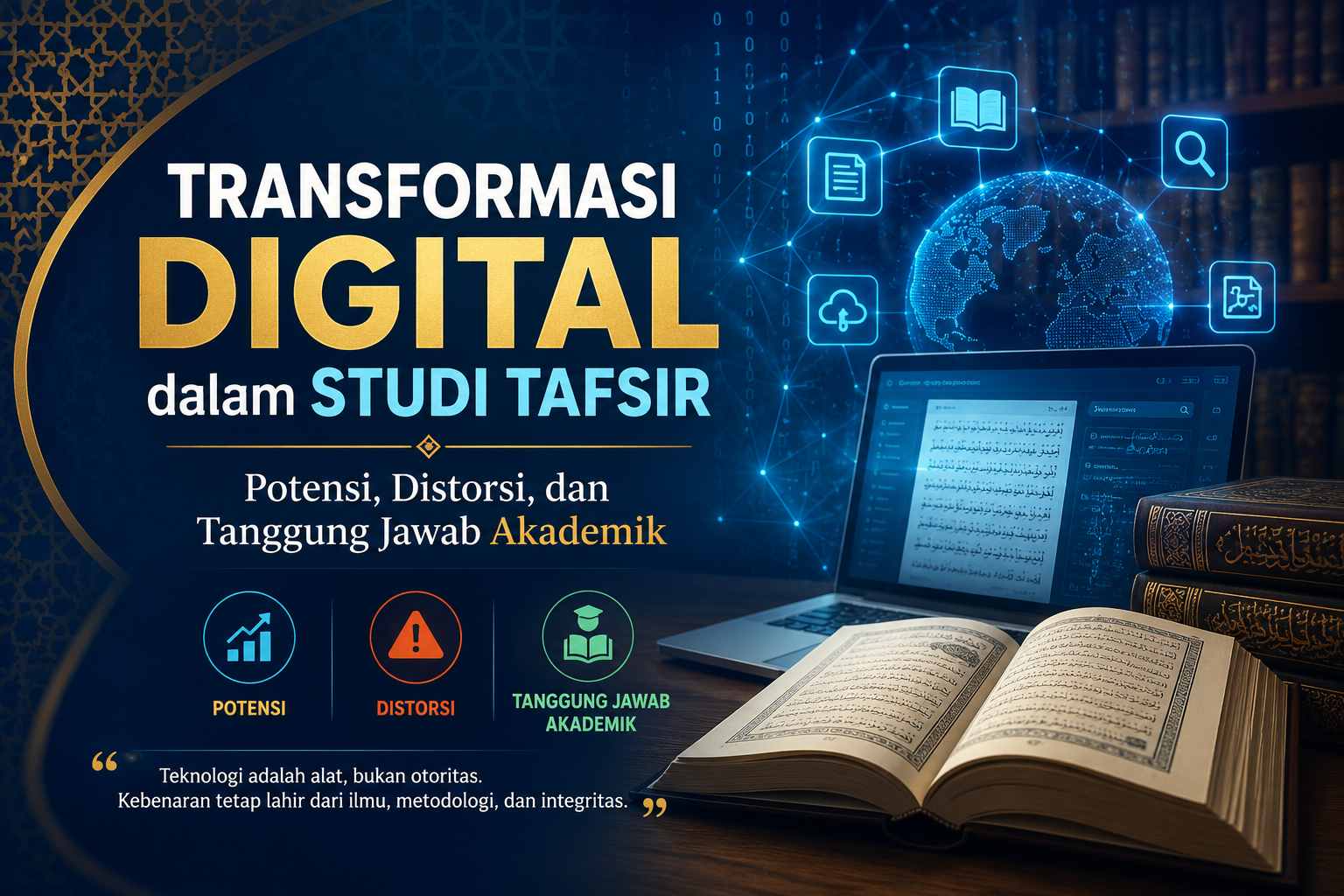
Transformasi Digital dalam Studi Tafsir: Potensi, Distorsi, dan Tanggung Jawab Akademik
Potensi, Distorsi, dan Tanggung Jawab Akademik
DOI:
https://doi.org/10.56874/kauniyah.v7i1.3127Abstract
The emergence of digital technology has fundamentally revolutionized how Muslims access, study, and disseminate the Qur'anic exegesis (tafsir). The digitization of interpretations poses three risks: loss of text authenticity, decreased validity of interpretations due to truncated context, and weakened scientific authority as interpretations are determined more by algorithms than by the competence of scholars. This article critically examines the dynamics of this digital transformation, highlighting the serious risk of semantic distortion that arises from truncated texts, decontextualized summaries, or inconsistencies with the original intent of the mufassir. Utilizing a qualitative study of popular Indonesian digital platforms, the research reveals that although accessibility has increased, certain digital content fails to fully adhere to authoritative texts and often neglects established methodological principles of interpretation. These findings emphasize the necessity of academic responsibility in harmonizing technological advancement with scholarly integrity, concluding that the digital transformation in tafsir studies can only yield positive contributions if strictly managed through rigorous academic control and ethical scholarship, necessitating wider digital tafsir literacy among users.
Downloads
References
Abd Hannan and Ach FatayillahMursyidi. “Social Media and the Fragmentation of Religious Authority among Muslims in Contemporary Indonesia.” Digital Muslim Review1, no. 2 (November 2023): 84–104. https://doi.org/10.32678/dmr.v1i2.10.
Abdul Rouf. “Digitization of Tafsir and Its Challenge to the Authority of Interpretation: A Review of Ulumul Qur’an.” Jurnal QOSIM Jurnal Pendidikan Sosial & Humaniora3, no. 2 (May 2025): 605–10. https://doi.org/10.61104/jq.v3i2.1056.
37Abdusshomad, Alwazir. “Peran Ustadz Influencer Dalam Penyebaran Dakwah Islam Kepada Generasi Z Melalui Media Sosial.” Muqaddimah: Jurnal Studi Islam15, no. 5 (December 2024): 63–75. https://doi.org/10.71247/8xzj0c92.
Achmad Tifaza Alfarizi, Munir, and Rizki Farabi. “Quran in the Digital Age.” Al-Bunyan: Interdisciplinary Journal of Qur’an and Hadith Studies2, no. 2 (January 2025): 116–26. https://doi.org/10.61166/bunyan.v2i2.24.
Ahmad Zainal Mustofa and Nurus Syarifah. “The ‘Ilm Al-Qur’an: A Study of Asbab An-Nuzul, Makkiyyah and Madaniyyah.” AL-IKHSAN: Interdisciplinary Journal of Islamic Studies2, no. 2 (November 2024): 203–14. https://doi.org/10.61166/ikhsan.v2i2.55.
Akbar, Ali. “Tawaran Hermeneutika Untuk Menafsirkan Alquran.” Wacana, Journal of the Humanities of Indonesia7, no. 1 (April 2005): 50. https://doi.org/10.17510/wjhi.v7i1.290.Ali, Muhdi, and Awan Farih. “Transforming Religious Authority: Islamic Epistemology in the Digital Age.” Rusydiah: Jurnal Pemikiran Islam6, no. 1 (2025): 19–37. https://doi.org/https://doi.org/10.35961/rsd.v6i1.2079.
Ali Sati, Abdul Halim, Abdul Hayy Nasution, and Muhammad Ridwan. “The Digital Transformation of Tafsir and Its Implications for Islamic Legal Derivation in the Contemporary Era.” MILRev: Metro Islamic Law Review4, no. 1 (June 2025): 389–415. https://doi.org/10.32332/milrev.v4i1.10425.
Ambo Dalle and Tobroni Tobroni. “Dimensi-Dimensi Dalam Beragama: Spiritual, Intelektual, Emosi, Etika, Dan Sosial.” Ikhlas : Jurnal Ilmiah Pendidikan Islam2, no. 1 (December 2024): 151–65. https://doi.org/10.61132/ikhlas.v2i1.302.
Andok, Mónika. “The Impact of Online Media on Religious Authority.” Religions15, no. 9 (September 2024): 1103. https://doi.org/10.3390/rel15091103.
Armita, Pipin. “Digital Da’wah and Quranic Interpretation: Opportunities, Distortions, and Ethics in the Spread of Interpretations on Social Media.” International Journal of Islamic Thought and Humanities4, no. 1 (May 2025): 154–64. https://doi.org/10.54298/ijith.v4i1.421.
Astor, Avi, Ghufran Khir-Allah, and Rosa Martínez-Cuadros. “Anonymity and Digital Islamic Authority.” Religions15, no. 12 (December 2024): 1507. https://doi.org/10.3390/rel15121507.
Athoillah, Sukijan, Muhammad Khakim Ashari, and Muhammad Badat Alauddin. “Religious Digital Literacy Of Urban Muslim Society In Indonesia: A Systematic Literature Review.” Akademika : Jurnal Pemikiran Islam28, no. 2 (November 2023): 141. https://doi.org/10.32332/akademika.v28i2.7088.Bednarkiewicz, Maroussia. “Regularity and Variation in Islamic Chains of Transmission.” In Semitic Languages and Cultures, 1st ed., vol. 22, edited by Teresa Bernheimer and Ronny Vollandt, 247–81. Cambridge, UK: Open Book Publishers, 2023. https://doi.org/10.11647/obp.0375.09.
38Berger, Akiva, and Oren Golan. “Online Religious Learning: Digital Epistemic Authority and Self-Socialization in Religious Communities.” Learning, Media and Technology49, no. 2 (April 2024): 274–89. https://doi.org/10.1080/17439884.2023.2169833.Bingaman, Kirk A. “Religion in the Digital Age: An Irreversible Process.” Religions14, no. 1 (January 2023): 108. https://doi.org/10.3390/rel14010108.Dozan, Wely, and Maliki. “Penerapan Metode Dan Pendekatan Tafsr Di Era Digital (Menimbang Urgensi Tafsir Di Era Digital).” El-Umdah (Jurnal Ilmu Al-Quran Dan Tafsir)7, no. 2 (December 2024): 259–79. https://doi.org/10.20414/elumdah.v7i2.12588.Eraku, Sunarti Suly, Mohamad Karmin Baruadi, Samuel Pd Anantadjaya, Siti Fadjarajani, Ucup Supriatna, and Ardian Arifin. “Digital Literacy And Educators Of Islamic Education.” Edukasi Islami: Jurnal Pendidikan Islam10, no. 01 (February 2021): 569. https://doi.org/10.30868/ei.v10i01.1533.Fadilla, Siti, and Putri Isma Indriyani. “When Algorithms Shape Trust: The Capitalist Transformation of Digital Islamic Da’wah in Indonesia.” Surau Journal of Islamic Studies1, no. 2 (July 2025): 86–103. https://doi.org/10.63919/surau.v1i2.34.Fakhrurrozi, Ach, Rofiqi Rofiqi, and Achmad Gazali. “The Development of an Inclusive Social Science Based Contextual Interpretation Model: A New Approach to Address Contemporary Challenges in Quranic Studies.” Al-Insyiroh: Jurnal Studi Keislaman10, no. 2 (September 2024): 249–85. https://doi.org/10.35309/alinsyiroh.v10i2.303.Fauzi, Farid. “Kepemimpinan Digital Dalam Dunia Pendidikan: Tinjauan Systematic Literature Review.” TA’LIM : Jurnal Studi Pendidikan Islam8, no. 2 (July 2025): 215–37. https://doi.org/10.52166/talim.v8i2.9433.Febriani, Ina Salmah, Utami Syifa Masfuah, and Ahya Ulyanti. “Analysis Of Digital Tafsir Literacy Competencies Among The Students OfBanten State Islamic University.” Ulumuddin: Jurnal Ilmu-Ilmu Keislaman14, no. 2 (December 2024): 393–412. https://doi.org/10.47200/ulumuddin.v14i2.2656.Febriani, Ina Syalmah, and Utami Syifa Masfuah. “Analysis Of Digital Tafsir Literacy Competencies Among The Students Of Banten State Islamic University.” Ulumuddin: Jurnal Ilmu-Ilmu Keislaman14, no. 2 (2024): 393–412. https://doi.org/https://doi.org/10.47200/ulumuddin.v14i2.2656.Firdaus, Muhammad Riyyan, and Mohamad Dindin Hamam Sidik. “Constructing Religious Legitimacy in the Digital Public Sphere: A Study of Islamic Discourse on Social Media.” Khazanah Theologia6, no. 2 (August 2024): 85–110. https://doi.org/10.15575/kt.v6i2.33173.Hafizi, Hafizi. “Asbab An-Nuzul Dalam Penafsiran Al-Qur’an (Aspek Sejarah Dan Kontekstual Penafsiran).” Al-Dzikra: Jurnal Studi Ilmu al-Qur’an Dan al-Hadits14, no. 1 (June 2020): 43–62. https://doi.org/10.24042/al-dzikra.v14i1.6047.
39Hamdani, Arfan, Rudi Hermawan, and Muhammad Samiran. “Pandangan Dunia Islam Dan Transformasi Digital: Antara Peluang Dan Tantangan.” TSAQOFAH5, no. 6 (August 2025): 6205–18. https://doi.org/10.58578/tsaqofah.v5i6.7217.Hamdi, Thon Thowi, and Masruhan Masruhan. “The Role of Digital Tools in Qur’anic Research and Tafsir: Improving Methodology and Interpretation.” AT-TURAS: Jurnal Studi Keislaman12, no. 1 (March 2025): 124–36. https://doi.org/10.33650/at-turas.v12i1.9895.Hasbi, Anang Fajar, Nurjannah Kasmilah, and Hamdani Hamdani. “The Circulation of Islamic Texts in The Global Network: Dynamics, Challenges and Implications in The Context of Education.” Insyirah: Jurnal Ilmu Bahasa Arab Dan Studi Islam8, no. 1 (June 2025): 122–35. https://doi.org/10.26555/insyirah.v8i1.13229.Hidayatulah, Ahmad Syarif, Mar’atus Sholikah, Imam Anas Hadi, Wahyu Nugroho, and Muhamad Hani Yusuf. “Strategies for Strengthening Digital Islamic Religious Education in Overcoming Religious Disinformation.” Journal of English Language and Education10, no. 3 (May 2025): 254–62. https://doi.org/10.31004/jele.v10i3.896.HM, Moh Yusuf, and Muhammad Satra. “Kajian Tafsir Al-Quran Di Era Digital: Literasi Dan Pengaruh Teknologi.” Jurnal Literasiologi12, no. 5 (2014): 226–39. https://doi.org/https://doi.org/10.47783/literasiologi.v12i5.863.Huda, Miftachul, Jibrail Bin Yusuf, Kamarul Azmi Jasmi, and Gamal Nasir Zakaria. “Al-Zarn?j?’s Concept of Knowledge (‘ Ilm).” Sage Open6, no. 3 (July 2016): 2158244016666885. https://doi.org/10.1177/2158244016666885.Husain, Malik Farrukh, and Abdul Ghaffar. “Digital Technological Tools in Quranic Studies and Their Impacts.” Pakistan Journal of Qur’?nic Studies4, no. 1 (2025): 1–17. https://doi.org/https://doi.org/10.52461/pjqs.v4i1.3823.Ichwan, Moh. Nor, Mustaqim Pabbajah, and Faizal Amin. “Digitization of Religious Tafsir: The Fading of Indonesian Ulama Authority in Post Truth Era.” Jurnal Studi Ilmu-Ilmu Al-Qur’an Dan Hadis25, no. 2 (September 2024): 320–45. https://doi.org/10.14421/qh.v25i2.5545.Ilyas, Moh, and Jauhar Maknun. “Strategi Pengembangan Literasi Keagamaan Dalam Pendidikan Islam Di Era Digital.” Journal of Education and Religious Studies3, no. 01 (April 2023): 08–12. https://doi.org/10.57060/jers.v3i01.70.Istiqomah, Dina, Muhammad Rusidi, and Opi Yensi. “Tafsir Digital: Antara Adaptasi Dan Krisis Otoritas Keagamaan.” Lathaif: Literasi Tafsir, Hadis Dan Filologi4, no. 1 (June 2025): 41. https://doi.org/10.31958/lathaif.v4i1.15416.Izzan, Ahmad. Metodologi Ilmu Tafsir. Bandung: Tafakur Kelompok Humaniora, 2014.Junaedi, Didi. Menafsir Teks, Memahami Konteks: Menelisik Akar Perbedaan Penafsiran Terhadap Al-Qur’an. Sleman: Deepublish Digital, 2018.
40Khadiq. “Transformation of Islamic Religious Practices in the Digital Era: Opportunities and Challenges for Contemporary Da’wah.” Jurnal Dakwah24, no. 2 (December 2023). https://doi.org/10.14421/jd.2023.24205.Leliana, Ayunita, Laily Maulida Septiana Harti, Fauris Zuhri, and Dwi Cahyani Sri Kusumaningtyas. “Digital Literacy: Text Credibility on Critical Reading Material.” JET ADI BUANA6, no. 01 (April 2021): 43–51. https://doi.org/10.36456/jet.v6.n01.2021.3512.Lukman, Fadhli. “Digital Hermeneutics and A New Face of The Qur`an Commentary: The Qur`an in Indonesian`s Facebook.” Al-Jami’ah: Journal of Islamic Studies56, no. 1 (June 2018): 95–120. https://doi.org/10.14421/ajis.2018.561.95-120.Maulana, Helmi. “Onlinization Tafsir: Studi Alquran Di Era Disrupsi.” TAJDID28, no. 1 (July 2021): 73. https://doi.org/10.36667/tajdid.v28i1.687.Maulidia, Martarosa, Mahdaro Finetri, and Muhammad Fahmi. “When Teachers Are Digital: Islamic Education, Artificial Intelligence, And Ibn S?n?’s Anxiety.” Kanz Philosophia: A Journal for Islamic Philosophy and Mysticism11, no. 1 (June 2025): 131–52. https://doi.org/10.20871/kpjipm.v11i1.418.Mittelstadt, Brent Daniel, Patrick Allo, Mariarosaria Taddeo, Sandra Wachter, and Luciano Floridi. “The Ethics of Algorithms: Mapping the Debate.” Big Data & Society3, no. 2 (December 2016): 2053951716679679. https://doi.org/10.1177/2053951716679679.Mubarok, Muhammad Fajar, and Muhammad Fanji Romdhoni. “Digitalisasi Al-Qur’an Dan Tafsir Sosial Media Di Indonesia.” Jurnal Iman Dan Spiritualitas1, no. 1 (February 2021): 110–14. https://doi.org/http://doi.org/10.15575/jis.v1i1.11552.Mukarom, Zaenal, Deni Darmawan, Mubiar Agustin, Jeane Siti Dwijantie, and Mochamad Ramdan Samadi. “Islamic Education Curriculum Innovation in the Digital Era: Challenges and Opportunities.” International Education Trend Issues2, no. 2 (September 2024): 317–28. https://doi.org/10.56442/ieti.v2i2.874.Muslim, Muslim. “Internalising Digital Technology in Islamic Education.” Scaffolding: Jurnal Pendidikan Islam Dan Multikulturalisme6, no. 3 (December 2024). https://doi.org/10.37680/scaffolding.v6i3.6309.Nariswari, Safira Widiana, and Mohammad Zakki Azani. “Islamic Learning Based on Digital Platforms.” Iseedu: Journal of Islamic Educational Thoughts and Practices8, no. 1 (May 2024): 127–43. https://doi.org/10.23917/iseedu.v8i1.8856.Ni’mah, Siar, Amir Hamzah, Hawirah Hawirah, Umar Umar, and Saifuddin Amin. “The Urban Muslim Thought In The Age Of Information: The Muhammadiyah’s Digital Qur’anic Interpretation.” Akademika : Jurnal Pemikiran Islam27, no. 2 (December 2022): 205. https://doi.org/10.32332/akademika.v27i2.5296.Nirwana An, Andri. “Tafsir Digital: Revolutionizing the Interpretation of Islamic Texts (Pre-Print).” Preprint, SSRN, 2024. https://doi.org/10.2139/ssrn.4860009.
41Nirwana, Andri. “Multimedia Tafsir: Exploring the Meaning of the Quran in the Digital Era.” Jurnal STIU Darul Hikmah10, no. 1 (March 2024): 1–8. https://doi.org/10.61086/jstiudh.v10i1.54.Nisa Kamila Labibah, and Siti Fathonah. “Konstruksi Ideologi Tafsir Website: Studi Analisis Terhadap Konten Tafsir Moderasi Beragama Dalam Tanwir.Id.” Academic Journal of Islamic Principles and Philosophy6, no. 1 (April 2025): 1–32. https://doi.org/10.22515/ajipp.v6i1.10341.Nuriana, Zulfa Ilma, and Nisrina Salwa. “Digital Da’wah in the Age of Algorithm: A Narrative Review of Communication, Moderation, and Inclusion.” Sinergi International Journal of Islamic Studies2, no. 4 (November 2024): 242–56. https://doi.org/10.61194/ijis.v2i4.706.Putra, D. I. Ansusa, and Mohammad Hidayaturrahman. “The Roles of Technology in Al-Quran Exegesis in Indonesia.” Technology in Society63 (November 2020): 101418. https://doi.org/10.1016/j.techsoc.2020.101418.Quran Kemenag, Quran Kemenag. “Quran Kemenag.” Qur’an Kemenag, November 15, 2025. https://quran.kemenag.go.id/quran/per-ayat/surah/2?from=1&to=286.Quran.com. “Tentang Kami.” November 15, 2025. https://quran.com/id/about-us.Quran.com, Quran. “Quran.Com.” Quran.com, 11 2025. https://quran.com/id/2?startingVerse=11.Rahman, Nida Al, and Ahmad Izzan. “Penerapan Metodologi Kritik Tafsir Rekonstruksi Evaluatif Dalam Kitab Bida’ Al-Tafâsîr.” Jurnal Iman Dan Spiritualitas3, no. 2 (September 2023): 355–62. https://doi.org/10.15575/jis.v3i2.29224.Ramlan, Aini Faezah, S. Salahudin Suyurno, Juritah Misman, and Rama Kertamukti. “Religious Literacy: Information Search Regarding Islam Among Virtual Citizens And Role Of Contemporary Preaching.” E-Journal of Islamic Thought & Understanding7, no. 1 (April 2024): 27–39. https://doi.org/10.24191/ejitu.v7i1.6049.Rifai, Achmad. “Tafsirweb: Digitalization Of Qur’anic Interpretation And Democratization Of Religious Sources In Indonesia.” Jurnal At-Tibyan: Jurnal Ilmu Alqur’an Dan Tafsir5, no. 2 (December 2020): 152–70. https://doi.org/10.32505/at-tibyan.v5i2.1640.Rijal Ali, and Subi Nur Isnaini. “Digitising Interpretation: Transforming Tafsir Al-Mishbah in the Context of the Living Quran.” Jurnal Studi Ilmu-Ilmu Al-Qur’an Dan Hadis25, no. 1 (May 2024): 1–23. https://doi.org/10.14421/qh.v25i1.5186.Saeed, Abdullah, and Ali Akbar. “Contextualist Approaches and the Interpretation of the Qur’?n.” Religions12, no. 7 (July 2021): 527. https://doi.org/10.3390/rel12070527.
42Saefulloh, Ahmad. “Contextual Tafsir and Digital Islam in Southeast Asia: A Narrative Review.” Sinergi International Journal of Islamic Studies2, no. 2 (May 2024): 109–22. https://doi.org/10.61194/ijis.v2i2.603.———. “Contextual Tafsir and Digital Islam in Southeast Asia: A Narrative Review.” Sinergi International Journal of Islamic Studies2, no. 2 (May 2024): 109–22. https://doi.org/10.61194/ijis.v2i2.603.Sambodo, Arjun Kristiyo and Mohamad Ali. “The Concept of Code of Ethics for Educators According to Imam Al-Ghazali: A Study of Classical Islamic Literature.” Belajea: Jurnal Pendidikan Islam10, no. 1 (May 2025): 87–98. https://doi.org/10.29240/belajea.v10i1.12730.Samsul Ariyadi. “The Qur’an, Digital Tools And The Transformation Of Religious Media.” Multidisciplinary Indonesian Center Journal (MICJO)2, no. 3 (July 2025): 2793–800. https://doi.org/10.62567/micjo.v2i3.937.Saputra, Edriagus, and Meki Johendra. “Eksistensi Sanad Terhadap Periwayatan Hadis.” Ikhtisar: Jurnal Pengetahuan Islam5, no. 1 (May 2025): 15–32. https://doi.org/https://doi.org/10.55062/2021/IJPI.Serepa, Amirah Saniyah. “Hoaks Keagamaan Hoaks Keagamaan Distorsi Tafsir Al-Qur’an Dan Strategi Verifikasi.” JURNAL PUSAKA15, no. 1 (June 2025): 1–10. https://doi.org/10.35897/ps.v15i1.1963.Shofa, Mila Faila, Ainun Yudhistira, and Syafawi Ahmad Qadzafi. “Digital Religion And Shifting Religious Authority: Understanding People’s Behaviour In Accessing Islamic Websites.” Al-A’raf : Jurnal Pemikiran Islam Dan Filsafat22, no. 1 (June 2025): 118–46. https://doi.org/10.22515/ajpif.v22i1.10454.Sihabussalam, Sihabussalam, Sa’idatul Lailah, and Roma Wijaya. “Digital Era Qur’anic Interpretation in Indonesia: Influence and Development on Contemporary Tafsir.” SUHUF: Jurnal Pengkajian Al-Qur;an Dan Budaya17, no. 1 (June 2024): 87–11. https://doi.org/https://doi.org/10.22548/shf.v17i1.998.Suhaila, Lukluk, Annisa Humairo, Ilham Nur Hasibuan, and Rahayu Fuji Astuti. “Tanggung Jawab Mahasiswa Terhadap Etika Akademik Dalam Membangun Budaya Ilmiah Yang Berintegritas.” AKADEMIK: Jurnal Mahasiswa Ekonomi & Bisnis5, no. 3 (September 2025): 1383–95. https://doi.org/10.37481/jmeb.v5i3.1510.Svensson, Jonas. “Computing Qur’ans: A Suggestion for a Digital Humanities Approach to the Question of Interrelations between English Qur’an Translations.” Islam and Christian–Muslim Relations30, no. 2 (April 2019): 211–29. https://doi.org/10.1080/09596410.2019.1603414.Syarif Hidayat. “Ragam, Problematika Dan Masa Depan Tafsir Al-Quran Digital.” SALIHA: Jurnal Pendidikan & Agama Islam5, no. 1 (January 2022): 115–29. https://doi.org/10.54396/saliha.v5i1.282.Syihabuddin, Muhammad, M. Hadi Masruri, and Fikri Qurrata Ayunin. “Textual Distortion in Hadith Transmission: A Critical Philological Analysis of Tash?f and Ta?r?f in
43Islamic Manuscript Tradition.” Tashwirul Afkar43, no. 2 (December 2024): 171–92. https://doi.org/10.51716/ta.v43i2.621.’Ulyan, Mohammad. “Digital Da’wah and Religious Authority: A Narrative Review of Islamic Preaching in the Social Media Era.” Sinergi International Journal of Islamic Studies1, no. 3 (November 2023): 100–113. https://doi.org/10.61194/ijis.v1i3.591.Zainal Abidin, Iqbal Muhajir Rul Koto, Achyar Zein, and Rahayu Fuji Astuti. “Masa Depan Tafsir Al-Qur’an Di Era Digital: Peluang, Tantangan, Dan Reorientasi Hermeneutika.” Mimbar Kampus: Jurnal Pendidikan Dan Agama Islam24, no. 2 (November 2025). https://doi.org/10.47467/mk.v24i3.8616.Zarkashi, Abu Abdillah Badruddin Muhammad bin Bahadur bin Abdullah al-. Al-Burha>n Fi> ’Ulu>m al-Qur’a>n. 1 vol. Kairo: Da>r al-Hadi>th, 2006.Zomorod, Faridah. “The Fundamentals (Usul) of Maqasidi Tafsir: An Investigation of the Concept and Its Applications in the Views of Early and Modern-Day Scholars.” Journal of Contemporary Maqasid Studies2, no. 1 (January 2023): 1–34. https://doi.org/10.52100/jcms.v2i1.94.
Downloads
Published
Issue
Section
License
Copyright (c) 2026 Al-Kauniyah: Jurnal Ilmu Al-Qurán dan Tafsir

This work is licensed under a Creative Commons Attribution-NonCommercial-ShareAlike 4.0 International License.

Al-Kauniyah: Jurnal Alquran dan Tafsir by Program Studi Ilmu Al-Qur'an dan Tafsir STAIN Mandailing Natal is licensed under a Lisensi Creative Commons Atribusi-NonKomersial-BerbagiSerupa 4.0 Internasional.