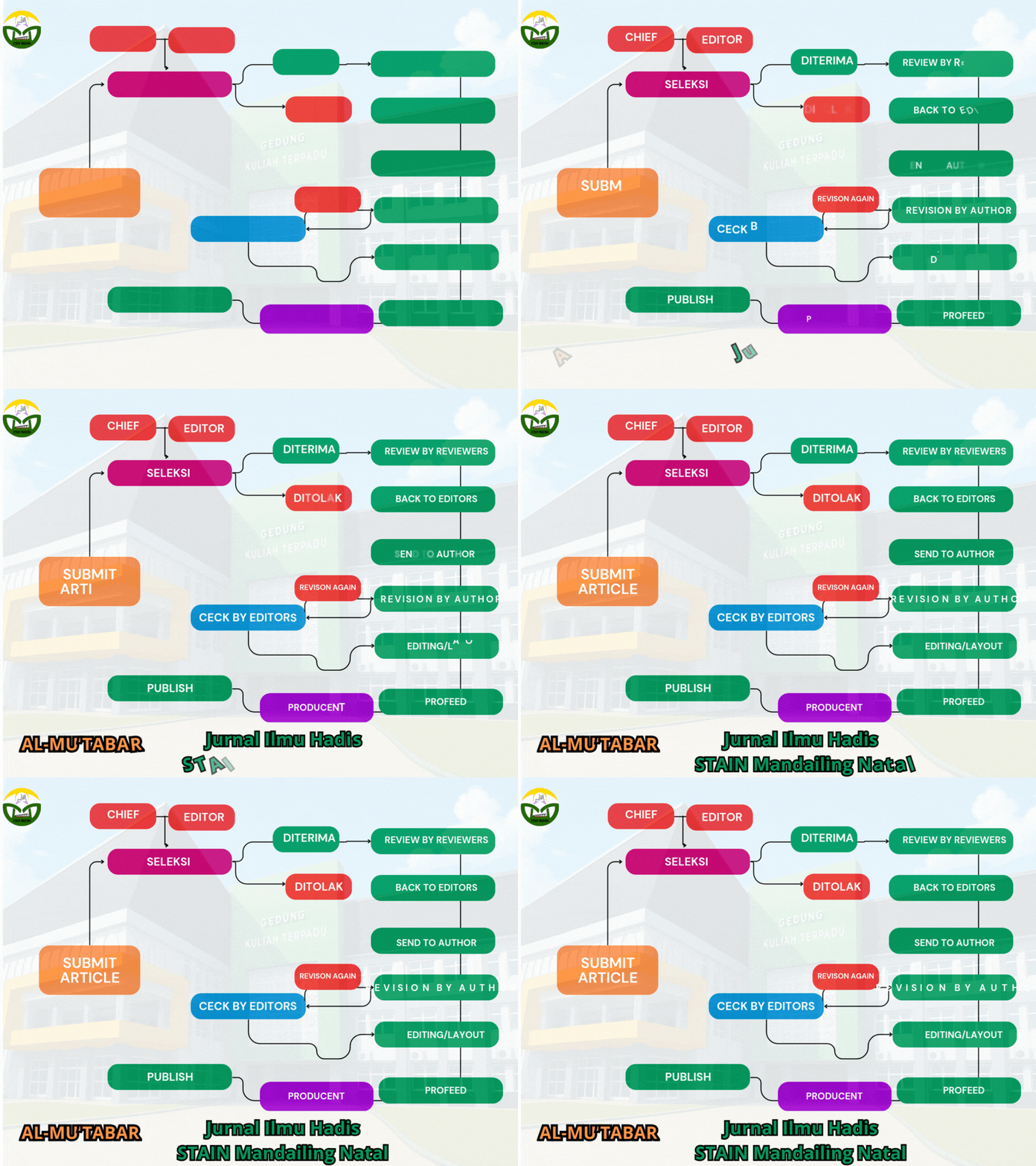



Peer Review Process
Every manuscript submitted to Al-Mu'tabar is independently reviewed by at least two reviewers in the form of "double-blind review". Editors will email selected Reviewers the title and abstract of the submission, as well as an invitation to log into the journal web site to complete the review. Reviewers enter the journal web site to agree to do the review, to download submissions, submit their comments, and select a recommendation. Decision for publication, amendment, or rejection is based upon their reports/recommendation. In certain cases, the editor may submit an article for review to another, third reviewer before making a decision, if necessary.
Each submitted article will be reviewed by three independent reviewers to ensure a thorough, objective, and rigorous evaluation process. All manuscripts submitted to the journal must have a maximum similarity or plagiarism level of 20%. Authors are expected to carefully follow the journal’s submission guidelines and use the prescribed manuscript format. If a submitted article does not comply with the journal’s guidelines or is written in a format different from the required template, the manuscript will be REJECTED by the editor before proceeding to the peer-review process.
Al-Mu’tabar Journal is published by the Hadith Studies Program, State Islamic College (Sekolah Tinggi Agama Islam Negeri/STAIN) Mandailing Natal, Indonesia. The journal has e-ISSN: 2774-9452 and p-ISSN: 2774-9460. Al-Mu’tabar Journal has proudly achieved a significant milestone by receiving Sinta 3 accreditation from the Ministry of Higher Education, Science, and Technology (Kemendiktisaintek) of the Republic of Indonesia in 2026. This prestigious accreditation was officially granted through Decree Number 862/DST/D.D1/HM.01.01/2026 and is valid until 2028. The Sinta 3 accreditation reflects the journal’s strong commitment to maintaining high standards of journal management, improving the quality of scholarly articles, strengthening the professionalism of its editorial and peer-review processes, and promoting high-quality academic publications that contribute meaningfully to the advancement of knowledge. This achievement also serves as an important motivation for the editorial team, editors, reviewers, and authors to continuously produce scholarly works that are high-quality, credible, innovative, and nationally competitive, while further strengthening the position of Al-Mu’tabar Journal as a trusted platform for scholarly publication in Indonesia.
Review Policy for Al-Mu'tabar:
- Peer Review Process: Nabawi Journal of Hadith Studies follows a rigorous peer review process to ensure the quality and integrity of the published articles. Upon submission, all manuscripts undergo a thorough review by qualified experts in the field of Hadith Studies.
- Reviewer Selection: Reviewers are selected based on their expertise, knowledge, and research experience in the specific area of Hadith Studies relevant to the manuscript. They should have a strong publication record and be affiliated with reputable academic institutions.
- Double-Blind Peer Review: The journal employs a double-blind peer review process, where the identities of both the authors and reviewers are kept confidential. This ensures an unbiased evaluation of the manuscript based solely on its scholarly merits.
- Reviewer Guidelines: Reviewers are provided with clear guidelines outlining the evaluation criteria, including the originality of the research, methodology, relevance to the field, clarity of presentation, and adherence to ethical standards. They are expected to provide constructive feedback, identify strengths and weaknesses, and suggest improvements to enhance the quality of the manuscript.
- Timely Review: The journal strives to maintain a prompt review process. Reviewers are requested to complete their assessments within a specified timeframe, typically within 4-6 weeks from the date of assignment. In case of any delays, reviewers are encouraged to notify the editorial office promptly.
- Editorial Decision: Based on the reviewers' feedback, the Editor-in-Chief or the assigned Associate Editor makes an informed decision regarding the manuscript. The possible decisions include acceptance, revision, resubmission, or rejection. The decision is communicated to the authors along with the reviewers' comments for further revision or action.
- Confidentiality: Reviewers are expected to treat all manuscripts as confidential documents and should not disclose any information regarding the manuscript to anyone outside of the review process. Authors' identities are also protected throughout the review process.
- Conflict of Interest: Reviewers are required to disclose any potential conflicts of interest that may affect their objectivity in reviewing a particular manuscript. If such conflicts arise, alternative reviewers will be assigned to ensure an unbiased evaluation.
- Revision and Resubmission: If the manuscript requires revisions, authors are provided with clear instructions and a reasonable timeframe to address the reviewers' comments. Revised manuscripts are re-evaluated to ensure that the required changes have been adequately addressed.
- Continuous Improvement: The journal welcomes feedback from reviewers and authors to improve its review process continually. Suggestions for enhancing the quality, transparency, and efficiency of the review process are highly valued and carefully considered.
By implementing this review policy, Nabawi Journal of Hadith Studies aims to uphold the highest standards of academic integrity and contribute to the advancement of Hadith Studies by publishing high-quality research in the field.
Review Criteria for Manuscript Evaluation
The reviewer will review the material according to the standard components of the article. If the content of the article deviates significantly, the reviewer will comment on it. Here is some review points:
- Title: The title must describe the subject of the manuscript adequately, clearly, precisely and without multiple interpretations. Please suggest a title if needed.
- Abstract: The abstract should briefly state the purpose of the study, the methods used, the results, and the core conclusions.
- Reference Review: Authors must give credit to the contributions of others relevant to the article through citations. The citation in the introduction must be able to show the innovation and/or novelty made by the author through gap analysis. Quotations / citations should not be excessive.
- Purpose: The purpose of the article review should be well explained and will be able to answer the hypothesis.
- Methods: The methods used to achieve the objectives should be described in a precise and sufficiently detailed manner so as to allow a competent reader to repeat the work done by the author. The tools, materials, hardware/software platforms and frameworks used in the research also need to be described.
- Clarity: The author must write information on the methods and research results in the article in a simple, concise and effective manner so that it is easily understood by the reader.
- Delivery organization: Manuscripts must develop/explain the research subject in a logical and effective manner.
- Duplication: Manuscripts do not repeat the description of the work that has been published by the author or other people. Check if the manuscript can be shortened without losing content by concatenating two or more tables and figures. Reviewers can provide some comments if there is duplication in the text.
- Calculations: In quantitative research, the Reviewer checks the accuracy of the calculations made by the authors.
- Tarjamatu ruwat (biography of Hadith's narrators): Reviewers also check the accuracy of names and biographies of The narrators randomly (if it is not possible to check one by one).
- Relation of Text to Tables and Figures: All tables and figures must be referred to in the text/paragraph. Statements in the text must match the contents of the table and figures.
- Table and Figure Titles: The title should state the content. If necessary, the reviewer will provide suggestions to improve the quality of table/figure titles.
- Graphics: Data for presenting graphs/images must be accurate.
- Conclusion: Conclusions to answer the hypothesis must be stated adequately and clearly and must be supported by data and testing.
- Allegation: The author must clearly distinguish between conjecture and fact.
- References: All references in the manuscript must be in the Bibliography. There are at least 20 references, 60% of which are primary references (scientific journals, proceeding articles, reference books, thesis/thesis/dissertation) and published in the last 5 (five) years (except turath books).