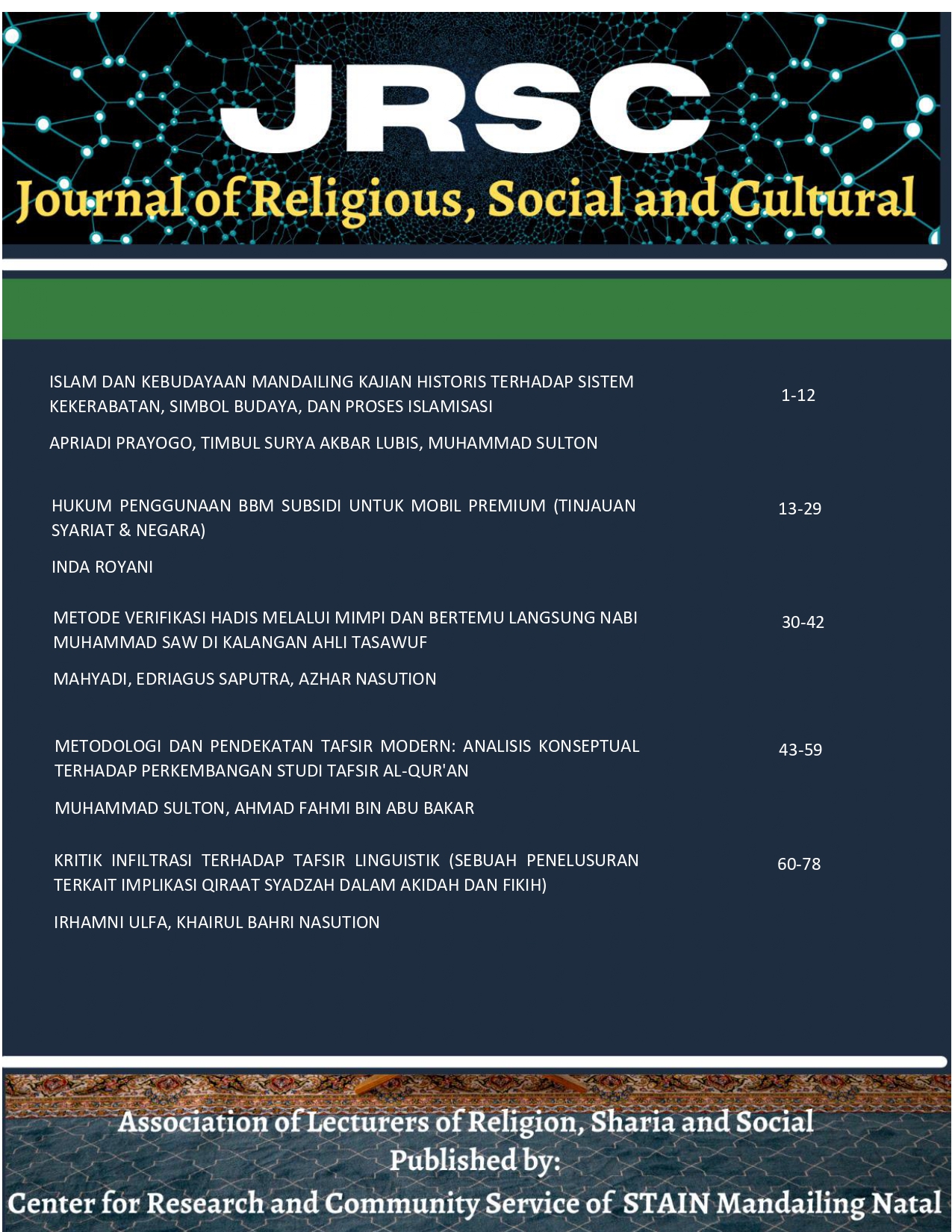
ISLAM DAN KEBUDAYAAN MANDAILING KAJIAN HISTORIS TERHADAP SISTEM KEKERABATAN, SIMBOL BUDAYA, DAN PROSES ISLAMISASI
Keywords:
Mandailing, sistem marga, Dalihan Na Tolu, Islamisasi, budaya lokalAbstract
This article examines the Mandailing people as one of the ethnic groups in North Sumatra with a distinctive social and cultural system. Mandailing society is founded upon the clan (marga) system, the customary institution of Dalihan Na Tolu, cultural symbols such as Gordang Sambilan, and the traditional institution of Bagas Godang, all of which have evolved alongside the process of Islamization. This study aims to analyze the historical development of the marga system, explore the philosophical meanings of Mandailing cultural symbols, and examine the process through which Islam spread and developed in the Mandailing region. The research employs a qualitative approach using a library research method. Data were collected from various scholarly sources on Mandailing history, cultural anthropology, and the development of Islam in North Sumatra, and analyzed through descriptive-analytical techniques involving data reduction, data presentation, and conclusion drawing. The novelty of this study lies in its integrated analysis of the marga system, Dalihan Na Tolu, Gordang Sambilan, Bagas Godang, and the Islamization process within a single analytical framework, providing a comprehensive understanding of the interaction between local culture and Islamic development in Mandailing. The findings reveal that the marga system serves as the foundation of Mandailing social and political identity, Dalihan Na Tolu functions as a mechanism of social integration that remains relevant after Islamization, Gordang Sambilan has transformed from a ritual instrument into a cultural symbol, and Bagas Godang represents the center of traditional governance founded upon deliberation and openness. The study also finds that Islamization occurred through a process of cultural acculturation, enabling Islam to integrate with local customs without eliminating Mandailing cultural identity. Consequently, the relationship between Islam and Mandailing culture is characterized by integration, adaptation, and mutual reinforcement, enriching the discourse on Islamic studies and local cultural heritage in Indonesia.
References
Budaya, E. N., Di, M., Godang, B., Simanjuntak, A., Hermalia, N., Harahap, A. H., Aulia, N., Sagala, H., Sari, L. A., Rizki, N. A., Harahap, A. S., & Harahap, M. B. N. (2026). Eksplorasi nilai-nilai budaya mandailing di bagas godang raja najunggal sebagai landasan praktik konseling lintas budaya 1. 11(3), 214–220.
Geertz, C. (1960). The Religion of Java. University of Chicago Press.
Harahap, B. H. (2004). Madina yang Madani. Pemerintah Kabupaten Mandailing Natal.
Koentjaraningrat. (1979). Manusia dan Kebudayaan di Indonesia. Djambatan.
Lbs, M. (2026). Hata Andung dalam Budaya Mandailing: Kajian Historis dan Makna Sosial. Advances in Education Journal, 2(4), 315–321. https://journal.al-afif.org/index.php/aej/article/view/870
Lubis, M. L. (n.d.). Sopo Godang dan Salipi Mandailing (Naskah ket).
Meuraxa, D. (t. t. ). (n.d.). Sejarah Kebudayaan Sumatera. Fa. Hasmar.
Pandapotan, H. S. (1983). Sejarah Ringkas Datuk Janggut Marpayung Aji. Tanpa penerbit.
Pane, S. (1965). Sejarah Indonesia (Jilid I) (1 ed.). Balai Pustaka.
Reid, A. (1993). Southeast Asia in the Age of Commerce 1450–1680. Yale University Press.
Rosadi, M., Muslim, U., & Al, N. (2022). 710-Article Text-2262-1-10-20220705. 2, 125–138.
Said, H. M. (n.d.). Soetan Koemala Boelan (Flora). Naskah ketik.
Sangti, B. (1977). Sejarah Batak. Kari Sianipar Company.
Tarigan, T. E., & Tambunan, E. (1974). Struktur dan Organisasi Masyarakat Toba. Nusa Indah.
Downloads
Published
Issue
Section
License
Copyright (c) 2026 Apriadi Prayogo, Timbul Surya Akbar Lubis

This work is licensed under a Creative Commons Attribution 4.0 International License.

This work is licensed under a Creative Commons Attribution 4.0 International License.