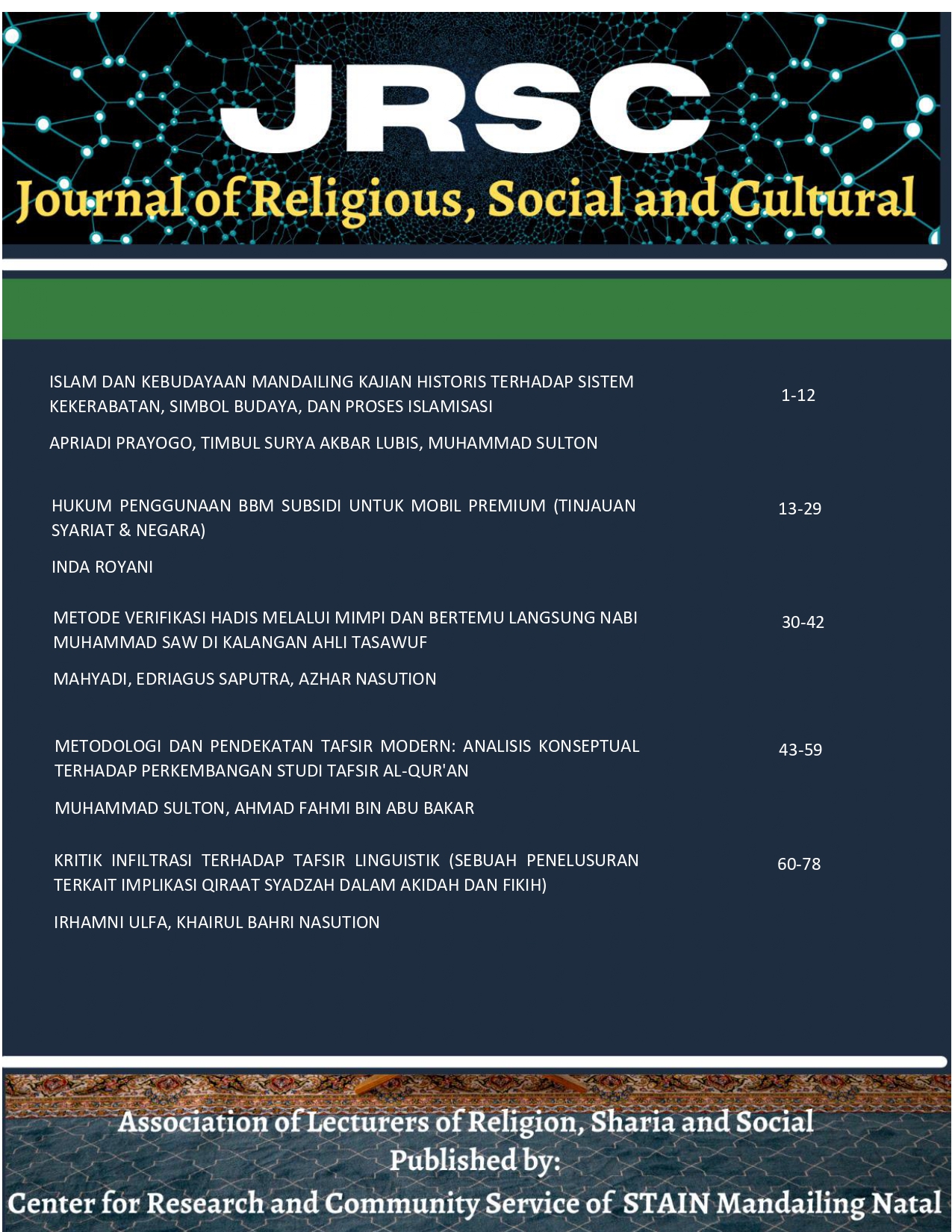
METODE VERIFIKASI HADIS MELALUI MIMPI DAN BERTEMU LANGSUNG NABI MUHAMMAD SAW DI KALANGAN AHLI TASAWUF
Keywords:
Hadith, Dream, SufiAbstract
Hadith refers to everything attributed to Prophet Muhammad SAW, including his sayings, actions, approvals, and characteristics. However, in the development of Islamic thought, there are hadiths received through dreams and then attributed to the Prophet Muhammad SAW. In the perspective of Sufis, dreaming of meeting the Prophet is considered a true encounter and can serve as a source of spiritual guidance, even as a basis for receiving hadith. One example is the hadith about coffee received by Sayyid Ahmad bin Ali Bahar Al-Qudaimi through a dream or spiritual encounter with Prophet Muhammad SAW. This study aims to determine the quality of the hadith from the perspective of hadith studies. This research employs a qualitative method with a library research approach by analyzing the sanad (chain of transmission), matan (text), and the views of hadith scholars as well as Sufi perspectives. The results show that the hadith received through dreams cannot be used as legal proof in Islamic law according to hadith scholars because it does not fulfill the requirements of sanad and matan authenticity. However, in the Sufi perspective, dreaming of meeting the Prophet Muhammad SAW is regarded as a true spiritual experience and may serve as spiritual guidance for the individual experiencing it.
References
Abdillah, M. H., & Soleh, K. (2023). Epistemologi Tasawuf Al-Jili dalam Pembelajaran Active Learning Pendidikan Agama Islam. QuranicEdu: Journal of Islamic Education, 3(1), 1–19. https://doi.org/10.37252/quranicedu.v3i1.498
Al Bakri, Z. M. (2024a). Melihat Rasulullah SAW di Alam Mimpi: Antara Kebenaran dan Dakwaan. Maktabah Al Bakri.
Al Bakri, Z. M. (2024b). Melihat Rasulullah SAW di Alam Mimpi: Antara Kebenaran dan Dakwaan. Maktabah Al Bakri.
Al-Ghazali, I. (2020). Ihya’‘Ulumuddin 10. Nuansa Cendekia.
Alim, M. (2010). PERDA BERNUANSA SYARIAH DAN HUBUNGANNYA DENGAN KONSTITUSI. JURNAL HUKUM IUS QUIA IUSTUM, 17(1), 119–142. https://doi.org/10.20885/iustum.vol17.iss1.art6
Dewi, R. S., & Mustafa, I. (2024a). ANALISIS HADIS KOPI: Studi Terhadap Hadis yang Diterima Sufi dari Nabi Muhammad Saw Melalui Mimpi. DIRAYAH: Jurnal Ilmu Hadis, 4(02), 219–241.
Dewi, R. S., & Mustafa, I. (2024b). ANALISIS HADIS KOPI: Studi Terhadap Hadis yang Diterima Sufi dari Nabi Muhammad Saw Melalui Mimpi. DIRAYAH: Jurnal Ilmu Hadis, 4(02), 219–241.
Dewi, R. S., & Mustafa, I. (2024c). ANALISIS HADIS KOPI: Studi Terhadap Hadis yang Diterima Sufi dari Nabi Muhammad Saw Melalui Mimpi. DIRAYAH: Jurnal Ilmu Hadis, 4(02), 219–241.
Dewi, R. S., & Mustafa, I. (2024d). ANALISIS HADIS KOPI: Studi Terhadap Hadis yang Diterima Sufi dari Nabi Muhammad Saw Melalui Mimpi. DIRAYAH: Jurnal Ilmu Hadis, 4(02), 219–241.
el-Bantanie, M. S. (2013). Dahsyatnya terapi wudhu. Elex Media Komputindo.
Hidayat, B. R., & Ma, A. (2026). YAQĀZAH DAN RU’YĀ: Menjemput Mimpi Bertemu Nabi صلى الله عليه وسلم. PENERBIT KBM INDONESIA.
Kartanegara, M. (2007). Nalar Religius: Memahami Hakikat Tuhan, Alam, dan Manusia. Erlangga.
Miftahuddin, M. (2020). Sejarah media penafsiran di Indonesia. Nun: Jurnal Studi Alquran Dan Tafsir Di Nusantara, 6(2), 117–143.
Nasrullah, M. (2020). Ibadah-Ibadah Paling Terhormat Bagi Pelaku Maksiat Agar Taubat Nasuha (Vol. 90). Araska Publisher.
Nuruddin, H. (2016). Mimpi Dalam Al-Qur’an (Pendekatan Psikologi Islam). MA thesis.
Safarianto, B. (t.t.). Diajukan Kepada Program Ilmu Agama Islam Sebagai Salah Satu Persyaratan Menyelesaikan Program Studi Strata Dua (S.2) Untuk Memperoleh Gelar Magister Di bidang Ilmu Tafsir.
Yakin, A. (2025a). KONSEP MIMPI KAUM SUFI PERSPEKTIF ABDUL GHANI AL NABULSI.
Yuminah, Y. (2018). Konsep mimpi dalam perspektif psikologi Islam: Studi komparasi psikologi Islam dan psikologi Barat. Jurnal Psikologi Islam, 5(2), 87–102.
Downloads
Published
Issue
Section
License
Copyright (c) 2026 Mahyadi, Edriagus Saputra, Azhar Nasution

This work is licensed under a Creative Commons Attribution 4.0 International License.

This work is licensed under a Creative Commons Attribution 4.0 International License.