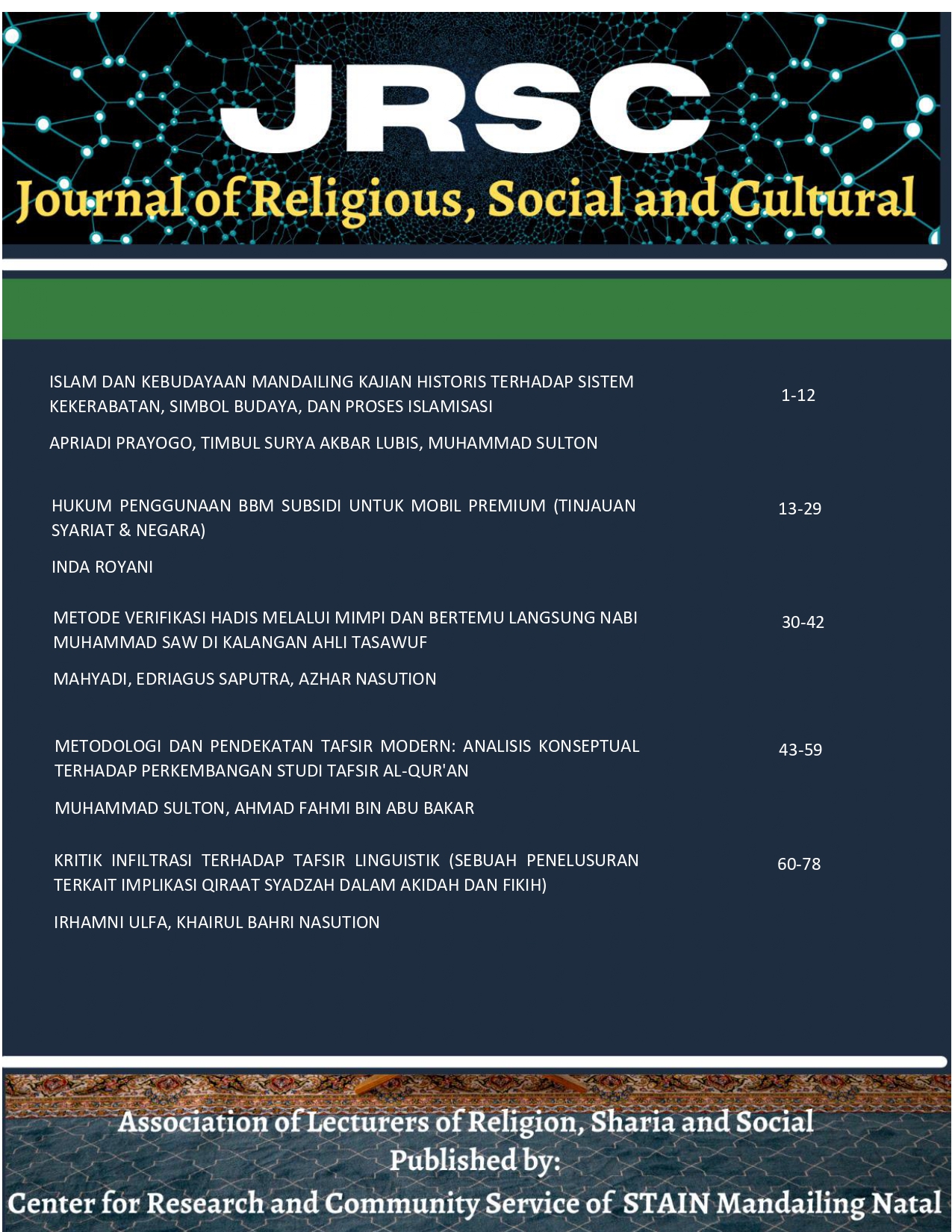
KRITIK INFILTRASI TERHADAP TAFSIR LINGUISTIK (SEBUAH PENELUSURAN TERKAIT IMPLIKASI QIRAAT SYADZAH DALAM AKIDAH DAN FIKIH)
Keywords:
Qirā’āt Syādzdzah, Linguistic Tafsir, Theology, Islamic Jurisprudence, Al-DakhīlAbstract
Qirā’āt syādzdzah are non-mutawātir variants of Qur’anic recitations that do not fulfill the requirements of canonical recitation, yet they still occupy an important position within the Islamic intellectual tradition, particularly in the fields of tafsir, theology, and Islamic jurisprudence. In the development of linguistic interpretation, qirā’āt syādzdzah are often used to broaden the meanings of Qur’anic verses and strengthen certain interpretations. However, their use has also generated debate because they are considered potentially part of infiltration (al-dakhīl) in tafsir, especially when used as the basis for theological doctrines and Islamic legal rulings. This study aims to examine the forms of infiltration in linguistic tafsir and to explore the implications of qirā’āt syādzdzah in theology and Islamic jurisprudence. This research employs a qualitative method using a library research approach and descriptive-analytical analysis. The data were obtained from classical books, academic journals, and various references related to qirā’āt syādzdzah, tafsir, and Qur’anic studies. The findings show that qirā’āt syādzdzah cannot be absolutely categorized as infiltration in tafsir because some of them possess authentic chains of transmission and were used by classical scholars to clarify the meanings of Qur’anic verses. In theological matters, qirā’āt syādzdzah cannot serve as the primary basis for establishing doctrines of faith because theology requires definitive and authoritative evidence. Meanwhile, in Islamic jurisprudence, these recitations may still function as supporting interpretations as long as they do not contradict stronger evidences. Therefore, the use of qirā’āt syādzdzah must remain proportional and within the proper methodological framework of tafsir in order to avoid deviations in understanding the Qur’an.
References
Al-Dhahabī, Muḥammad Ḥusain. Al-Tafsīr wa al-Mufassirūn. Jil. 1. Kairo: Dār al-Ḥadīth, 2005.
Al-Ḥamdānī, Abū al-A‘lā. Al-Tadzkirah fī al-Qirā’āt al-Syādzdzah. t.t.
Al-Jazarī, Ibn. Al-Nasyr fī al-Qirā’āt al-‘Asyr. Jil. 1. t.t.
Al-Manīsī, W. Ātsār Ikhtilāf al-Qirā’āt al-Arba‘ ‘Asyr fī Mabāḥits al-‘Aqīdah wa al-Fiqh. t.t.
Al-Qaṭṭān, Mannā‘. Mabāḥits fī ‘Ulūm al-Qur’ān. Kairo: Maktabah Wahbah, 2000.
Al-Zuḥaylī, Wahbah. Al-Fiqh al-Islāmī wa Adillatuh. Jil. 3. Damaskus: Dār al-Fikr, 1985.
Bazmūl, Muḥammad ibn ‘Umar. Al-Qirā’āt wa Ātsāruhā fī al-Tafsīr wa al-Aḥkām. Jil. 1. Riyadh: Dār al-Hijrah, 1966.
Husna, Nihyatul. “Studi Kritis al-Dakhīl: Qirā’at Syādzdzah dalam Penafsiran Al-Qur’an.” El-Mu‘Jam: Jurnal Kajian Al-Qur’an dan Al-Hadis 5, no. 1 (2015).
Irham, Muhammad. “Implikasi Perbedaan Qirā’at terhadap Penafsiran Al-Qur’an.” Al-Bayān: Jurnal Studi Ilmu Al-Qur’an dan Tafsir 5, no. 1 (2020).
Makmum, Nurcholis. “Qirā’at Syādzdzah dan Ahādiyah.” Jurnal Islam Pesisir dan Kajian Keislaman (2024).
Mas’ud, dkk. “Qirā’at Syādzdzah dalam Tafsir Baḥr al-Muḥīṭ.” Al-Karīmah: Jurnal Studi Ilmu Al-Qur’an dan Tafsir (2024).
Shihab, M. Quraish. Kaidah Tafsir. Jakarta: Lentera Hati, 2013.
Sugiyono. Metode Penelitian Kualitatif. Bandung: Alfabeta, 2020.
Zahrah, Muḥammad Abū. Uṣūl al-Fiqh. Kairo: Dār al-Fikr al-‘Arabī, 1958.
Downloads
Published
Issue
Section
License
Copyright (c) 2026 Irhamni Ulfa, Khairul Bahri Nasution

This work is licensed under a Creative Commons Attribution 4.0 International License.

This work is licensed under a Creative Commons Attribution 4.0 International License.