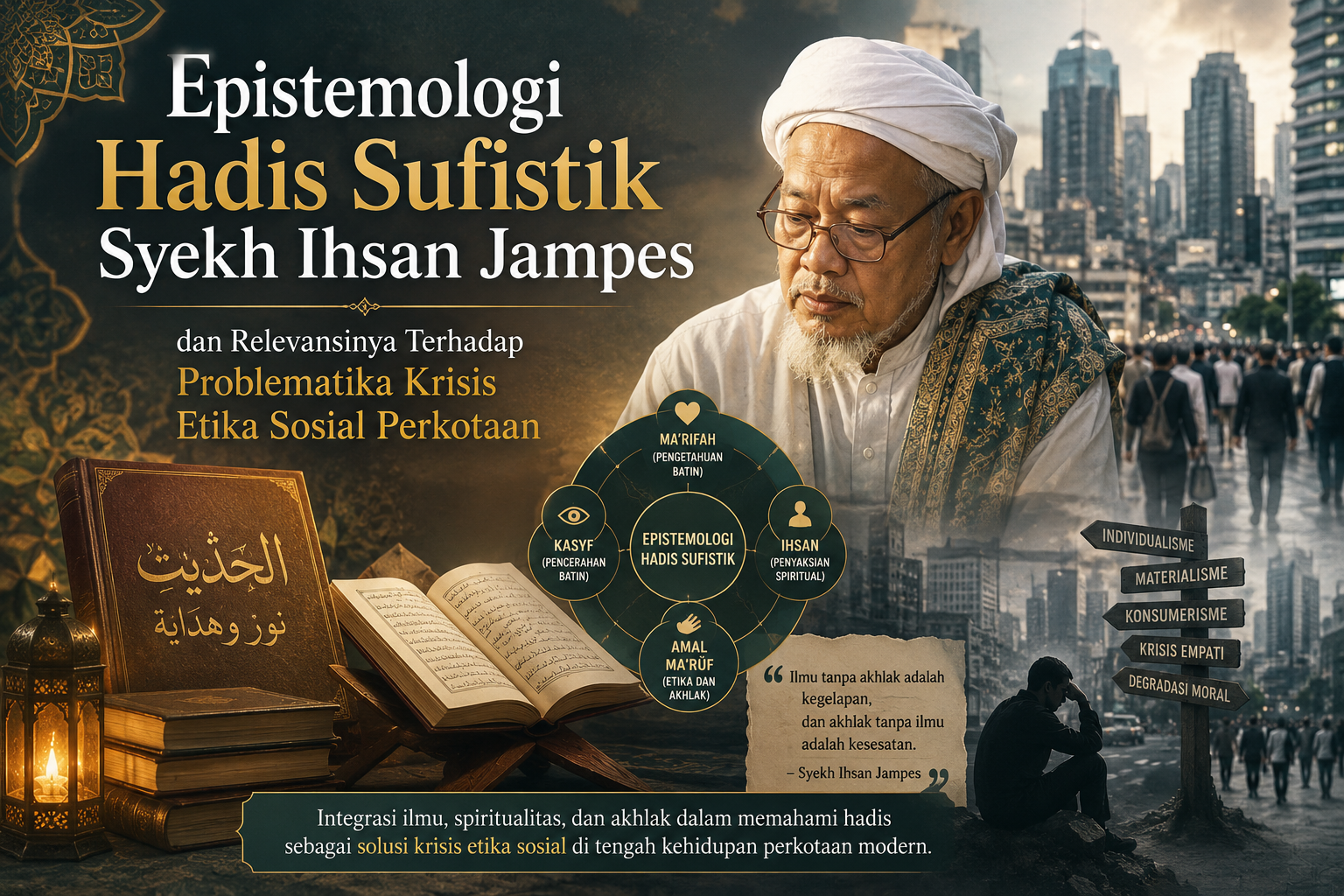
Epistemologi Hadis Sufistik Syekh Ihsan Jampes dan Relevansinya Terhadap Problematika Krisis Etika Sosial Perkotaan
The Epistemology of Sufistic Hadith in the Thought of Shaykh Ihsan Jampes and Its Relevance to the Ethical Crisis in Urban Society
DOI:
https://doi.org/10.56874//almutabar.2026.v6i1/3131/5Keywords:
Sufistic Hadith, Shaykh Ihsan Jampes, Kibr and ‘ujub, Urban Social Problems, Islamic EpistemologyAbstract
Urban social problems in the modern era are characterized by the intensification of identity crises, symbolic competition culture, and tendencies toward social narcissism that trigger alienation and weaken the collective ethics of urban society. These phenomena indicate that urban social problems do not merely stem from structural and economic aspects, but are also rooted in the epistemological and spiritual problems of human beings. This article aims to examine the epistemology of Sufistic hadith in Shaykh Ihsan Jampes’ Kitab Manāhij al-Imdād and to analyze its relevance to urban social problems. This study employs a qualitative method based on textual analysis with an integrative Islamic epistemological approach emphasizing bayānī and ‘irfānī reasoning. The analysis focuses on how Shaykh Ihsan Jampes understands hadiths concerning arrogance (kibr) and self-admiration (‘ujub) as inner spiritual diseases that disrupt the formation of ethical consciousness and human identity. The findings reveal that Shaykh Ihsan Jampes’ Sufistic hadith epistemology positions kibr and ‘ujub not merely as individual moral violations, but as epistemological disturbances that damage human social and spiritual relations. This perspective has significant relevance in understanding urban social problems, particularly within the context of performative culture, social egoism, and community fragmentation. This article affirms that the integration of Sufistic hadith epistemology can enrich urban management discourse through the strengthening of social ethics, identity resilience, and urban human development oriented toward spiritual values.
Downloads
References
Al-Ghazali, Abu Hamid. Iḥyā’ ‘Ulūm Al-Dīn, Jil. 4. Beirut: Dar al-Ma’rifah, n.d.
Al-Ghazālī, Abū Ḥāmid. Iḥyā’ ‘Ulūm Al-Dīn, Juz I. Beirut: Dar al-Ma’rifah, n.d.
———. Iḥyā’ ‘Ulūm Al-Dīn, Juz III. Beirut: Dar al-Ma’rifah, n.d.
Al-Ḥajjāj, Muslim ibn. Ṣaḥīḥ Muslim, Kitāb Al-Īmān, Bāb Taḥrīm Al-Kibr. Beirut: Dār Iḥyā’ al-Turāth al-‘Arabī, 91AD.
Al-Jabiri, Muhammad Abid. “Bunyah Al-‘Aql Al-‘Arabi.” Beirut: Al-Markaz Al-Tsaqafi Al-Arabi, 1991.
Al-Kadiri, al-Syekh Ihsan Muhammad Dahlan al-Jamfasi. Manahij Al-Imdad ’Ala Syarh Irsyad Al-’Ibad Ila Sabil Al-Rashad, Vol I. Kediri: Perpustakaan Ubaidillah Arsyad, 2006.
———. Manahij Al-Imdad ’Ala Syarh Irsyad Al-’Ibad Ila Sabil Al-Rashad, Vol II. Kediri: Perpustakaan Ubaidillah Arsyad, 2006.
Al-Sakandarī, Ibn ‘Aṭā’ Allāh. Al-Hikam. Beirut: Dar al-Kutub al-‘Ilmiyyah, 2003.
Al-Tirmidhī. Sunan Al-Tirmidhī, Kitāb Al-Birr Wa Al-Ṣilah. Beirut: Dār al-Gharb al-Islāmī, 1998.
Alesaily, Zaker, and Ahmed Albialy. “Urban Identity: A Bibliometric Review, 1969–2024.” Alexandria Engineering Journal 128 (2025): 724–46.
Amin, Ash, and Nigel Thrift. Cities: Reimagining the Urban, 2002.
Bauman, Zygmunt. Identity: Coversations with Benedetto Vecchi. John Wiley & Sons, 2013.
———. “Liquid Modernity. Polity. Press.” Oxford.(Russ. ed.: Bauman Z. Tekuchaja sovremennost’. SPb: Piter Publ., 2008., 2000.
Bourdieu, Pierre, and John G Richardson. “Handbook of Theory and Research for the Sociology of Education.” The Forms of Capital 241 (1986): 258.
Bowen, Glenn A. “Document Analysis as a Qualitative Research Method.” Qualitative Research Journal 9, no. 2 (2009): 27–40.
Creswell, John W, and Cheryl N Poth. Qualitative Inquiry and Research Design: Choosing among Five Approaches. Sage publications, 2016.
Dalle, Ambo, and Tobroni Tobroni. “Dimensi-Dimensi Dalam Beragama: Spiritual, Intelektual, Emosi, Etika, Dan Sosial.” Ikhlas: Jurnal Ilmiah Pendidikan Islam 2, no. 1 (2025): 151–65.
Dear, Michael, Gary D Allinson, Edward J Malecki, John S Adams, Robert A Beauregard, and Richard L Nostrand. “The Production of Space Henri Lefebvre.” Urban Geography 14, no. 5 (1993): 489–503.
Denzin, Norman K, and Yvonna S Lincoln. The Sage Handbook of Qualitative Research. sage, 2011.
Evers, Hans-Dieter, and Rudiger Korff. Urbanisme Di Asia Tenggara: Makna Dan Kekuasaan Dalam Ruang-Ruang Sosial. Yayasan Pustaka Obor Indonesia, 2002.
Hidayatullah, Syarif. “Pemikiran Tasawuf Nasaruddin Umar Dan Relvansinya Bagi Kehidupan Masyarakat Urban.” UIN Fatmawati Sukarno Bengkulu, 2025.
———. “Pemikiran Tasawuf Nasarudin Umar Dan Relevansinya Bagi Kehidupan Masyarakat Urban.” UIN Fatmawati Sukarno Bengkulu, 2025.
Kanter, Beyhan, and Buşra Ataker Güneş. “The Loss of Values and Critique of Modernism in Şükrü Erbaş’s Poems.” Ordu Üniversitesi Sosyal Bilimler Enstitüsü Sosyal Bilimler Araştırmaları Dergisi 15, no. ISRIS 2025 (2025): 204–25.
Khadijah. “Urban Sufism: Membangun Kecerdasan Spiritual Masyarakat Perkotaan Era Modern.” Medina-Te: Jurnal Studi Islam 19, no. 1 (2023): 32–43.
King, Loren. “Henri Lefebvre and the Right to the City.” In The Routledge Handbook of Philosophy of the City, 76–86. Routledge, 2019.
Kostko, Natalya A, and Irina F Pecherkina. “Urban Identity and Perception of the City in Management Discourse.” Социологическая Наука и Социальная Практика 12, no. 1 (2024): 136–61.
Lestari, Afifah. “The Influence of Social Structure on Legal Compliance in Urban Societies.” Legal System Journal 1, no. 1 (2024): 8–17.
Miles, Matthew B, A Michael Huberman, and Johnny Saldana. “Qualitative Data Analysis: A Methods Sourcebook.” (No Title), 2014.
Mu’tamar, Mu’tamar, Abdul Djamil, and Nanang Nurcholis. “Warisan Tasawuf Akhlaqi Syekh Sholeh Darat Dan Syekh Ihsan Jampes: Warisan Tasawuf Akhlaqi Syekh Sholeh Darat Dan Syekh Ihsan Jampes.” Educativa: Jurnal Pendidikan Agama Islam 1, no. 2 (2023): 32–44.
Mustofa, Farid. “Urban Sufism: The New Spirituality of Urban Communities in Indonesia,” 2012.
Nasr, Sayyed Hossein. Knowledge and the Sacred. New York. New York: State University of New York Press, 1989.
Ni’am, Syamsun. “The Debate of Orthodox Sufism and Philosophical Sufism: The Study of Maqāmāt in the Sirāj Al-Ṭālibīn of Shaykh Iḥsān Jampes.” Al-Jami’ah: Journal of Islamic Studies 58, no. 1 (2020): 1–34.
Paone, Michael. “Left on the Cutting Room Floor: Christopher Lasch, Eugene D. Genovese and Beyond the New Left, 1965-1970.” The George Washington University, 2025.
Pelling, Mark. The Vulnerability of Cities: Natural Disasters and Social Resilience. Routledge, 2012.
Putnam, Robert D. Bowling Alone: The Collapse and Revival of American Community. Simon and schuster, 2000.
Ridwan, Ridwan, Hamzah Harun, and Muhaimin Muhaimin. “Urban Sufisme Di Era Digital Dan Urban Salafi Di Era Kontemporer: Urban Sufism in the Digital Era and Urban Salafism in the Contemporary Era.” AL-QIBLAH: Jurnal Studi Islam Dan Bahasa Arab 3, no. 4 (2024): 468–80.
Rofi’í, Muhammad Arwani. “Aksiologi Hadith Dan Sunnah: Resultansi Antara Tradisi Dan Ajaran (Komparasi Pandangan Orientalis Dan Ulama Islam Tentang Hadith Dan Sunnah).” Al-I’jaz : Jurnal Studi Al-Qur’an, Falsafah Dan Keislaman 4, no. 1 (2022): 28–43. https://doi.org/https://doi.org/10.53563/ai.v4i1.73.
Rofi’i, Muhammad Arwani, Nurin Alfiani, and Barda Royyan Hanafi. “The Relevance of The Story of Ashabul Kahfi in Tafsir Al-Maraghi As A Solution To The Identity Crisis of The Millennial Generation.” AL ITQAN: Jurnal Studi Al-Qur’an 9, no. 1 (2023): 108–35.
Rofi’i, Muhammad Arwani, Puri Emilda, and Emilia Rachmawati. “The Dimension of Sincerity According To The Qur’an And Sunnah: The Key To Accepting Deeds.” International Journal of Research 2, no. 1 (2024): 53–68.
Rofi’i, Muhammad Arwani, Nazilatul Fatihah Firdaus, and Emilia Rachmawati. “Sincerity and Devotion-Based Education:(Case Study at Al-Ishlah Lamongan Islamic Boarding School).” Syaikhuna: Jurnal Pendidikan Dan Pranata Islam 15, no. 1 (2024): 34–47. https://doi.org/https://doi.org/10.62730/syaikhuna.v15i1.7308.
Rofi’i, Muhammad Arwani, Fuji Lestari, Anis Ulfiyatin, Muhammad Rafsanjani, and Nurin Alfiani. “Konsep Kedermawanan Dan Etika Sosial Dalam Pemikiran Ibn Miskawayh: Kajian Aksiologi ZISWAF Dalam Tahdzib Al-Akhlaq.” ZISWAF ASFA JOURNAL 3, no. 1 (2025): 65–86.
Rosyadi, Hasib. “Pendidikan Sufistik Kiai Ihsan Jampes Dan Relevansinya Di Era Modern.” IAIN Kediri, 2021.
Sennett, Richard. The Corrosion of Character: The Personal Consequences of Work in the New Capitalism. WW Norton & Company, 1998.
Stoker, Gerry. “Governance as Theory: Five Propositions.” International Social Science Journal 50, no. 155 (1998): 17–28.
Turner, Bryan S. Religion and Modern Society: Citizenship, Secularisation and the State. Cambridge University Press, 2011.
Twenge, Jean M. “The Evidence for Generation Me and against Generation We.” Emerging Adulthood 1, no. 1 (2013): 11–16.
Wasid, Wasid. Tasawuf Nusantara Kiai Ihsan Jampes Menanggapi Jalan Ma’rifat, Menjaga Harmoni Umat. Pustaka Idea, 2016.
Weber, Max, and Stephen Kalberg. The Protestant Ethic and the Spirit of Capitalism. Routledge, 2013.
Zed, Mestika. Metode Penelitian Kepustakaan. Jakarta: Pustaka Obor Indonesia, 2014.
Downloads
Published
Issue
Section
License
Copyright (c) 2026 Muhammad Arwani Rofii, Siti Fatimatuz Zahroh

This work is licensed under a Creative Commons Attribution-NonCommercial-ShareAlike 4.0 International License.

Al-Mu'tabar is licensed under a https://creativecommons.org/licenses/by-nc-sa/4.0/