
Symbolism, Space, and Social Connectedness in the Nggowo Lemah Tradition: Revisiting the Logic of Local Culture
DOI:
https://doi.org/10.56874/sm-jis.v1i1.2851Keywords:
Nggowo Lemah, Javanese Culture, Social ChangeAbstract
This study aims to examine the cultural meaning, psychological function, and dynamics of the transformation of the nggowo lemah tradition in the context of house moving among Javanese communities in three villages: Calungan, Beru, and Candisari. This study uses a qualitative approach with in-depth interviews, direct observation, and interpretive analysis of the informants' lived experiences. The research findings indicate that nggowo lemah is practiced as a simple and adaptive domestic custom that focuses on the symbolic act of carrying a handful of soil from the old house to the new one. This tradition has a strong emotional function, especially in building a sense of security, spatial continuity, and attachment to the original environment, without being related to religious legitimacy. The results also reveal a generational shift, where younger groups tend to abandon this practice due to a more practical orientation to life, so that its sustainability is highly dependent on social and emotional relevance in the context of modern society. Overall, this study confirms that nggowo lemah is a cultural practice that functions as a psychosocial transition mechanism in the process of adaptation to a new space.
Downloads
References
Aḥmad ibn Idrīs al-Qarāfī. (1998). Al-Furūq. Dār al-Kutub al-‘Ilmiyyah.
Anastasya, A. (2024). Pengaruh Globalisasi Terhadap Struktur Sosial dan Hubungan Antar Generasi di Desa Adat Sade. Jurnal Inovasi Global, 2(1).
Annisa, S. Y. (2024). Tedhak Siten: Its Existence and Cultural Values During the Fast Pacing World. Linguistik Terjemahan Sastra (LINGTERSA), 5(1), 48–57.
A’yun, B. A. Q., Aini, S. N., Assyihabi, R., & Setiawan, B. (2024). Transformasi makna budaya tradisi nguras enceh pada generasi milenial. Humanika: Kajian Ilmiah Mata Kuliah Umum, 24(1), 67–78.
Beatty, A. (1999). Varieties of Javanese religion. An Anthropological Account.
Bernanda, Y., Qomariah, I., & Mandasari, E. (2025). Analisis Konflik Tanah dalam Konteks Hukum Adat. Jejak Digital: Jurnal Ilmiah Multidisiplin, 1(3), 516–523.
Bourdieu, P. (2020). Outline of a Theory of Practice. In The new social theory reader (pp. 80–86). Routledge.
Bowen, M. (1993). Family therapy in clinical practice. Jason Aronson.
Brilyandio, F. (2021). Orang jawa menjaga keharmonisan (tinjauan filsafat moral kant dalam upacara tradisional nyadran). 50(1), 34–49.
Casey, E. S. (1993). Getting back into place: Toward a renewed understanding of the place-world. Indiana University Press.
Damayanti, S., Fadilah, S. R., Qiyantasari, Y. A., & Aruman, T. (2025). Analisis Dampak Sosial Ekonomi Relokasi Permukiman Kolong Pasupati ke Rusunawa Solokan Jeruk. Jurnal Riset Rumpun Ilmu Sosial, Politik Dan Humaniora, 4(1), 255–268.
Daryanti, U., & Nurjannah, S. (2021). Analisis ‘Urf terhadap Tradisi Janur Kuning Dalam Adat Pernikahan Jawa Di Kabupaten Luwu Timur. Shautuna: Jurnal Ilmiah Mahasiswa Perbandingan Mazhab.
Gabe, R. T., & Lestari, A. P. (2018). Menelaah Teritorialitas Kelompok Sosial Penghuni di RUSUNAWA: Proses Home-Making Warga Relokasi. NALARs, 17(2), 87–96.
Geertz, C. (1976). The religion of Java. University of Chicago press.
Hariyanto, P., Nardiati, S., Endardi, J., Sukesti, R., & Heryana, N. (2024). Linguistic and symbolic meanings in ethnic communities: A case study of Tedhak Siten traditional ceremony. International Journal of Society, Culture & Language, 12(1), 293–311.
IB-C2. (2025, October 25). Wawancara Pribadi (Fajrul Falah Al-Azhari, Interviewer).
Indra, I. R. F., & Salikurrahman, L. M. (2024). Prespektif Simbolik Dalam Budaya Ritual Slametan: Studi Kasus Di Masyarakat Islam Jawa. Maulana Atsani: Jurnal Pendidikan Multidisipliner, 1(2), 53–59.
Khusni, A. R. (2025). Peran Kearifan Lokal dalam Memperkuat Identitas Masyarakat Tengger di Kabupaten Probolinggo. Jurnal Ilmu Pendidikan dan Kearifan Lokal (JIPKL), 5.
Kiftiyah, M. (2020). Penanaman Rasa Syukur Melalui Tradisi Sedekah Bumi di Desa Tegalarum, Demak: Kajian Indigenous Psikologi. Dinamika Sosial Budaya, 22(2).
Leach, E. R. (1976). Culture and communication: The logic by which symbols are connected. An introduction to the use of structuralist analysis in social anthropology. Cambridge University Press.
Lestari, K. P., Nur, D. M. M., & Karim, A. (2025). Representasi Tindakan Sosial dalam Tradisi Lokal Masyarakat di Era Modern. Entita: Jurnal Pendidikan Ilmu Pengetahuan Sosial Dan Ilmu-Ilmu Sosial, 7(1), 97–114.
Maksum, S. R., Putri, G. A., & Efendi, A. N. (2025). Kepercayaan dan Praktik Budaya dalam Film Tari Kematian: Pendekatan Antropologi Sastra Victor Turner. Lingua Skolastika, 4(1), 72–84.
Nuraini, C., & Suprayitno, S. (2021). Karakter Lingkungan Perumahan Berbasis Space Attachment Yang Adaptif Dan Responsif Di Mandailing. NALARs, 20(1), 61–72.
Nurlia, N., & Nurasiah, N. (2017). Sunrang Tanah Sebagai Mahar Untuk Meningkatkan Identitas Diri Perempuan Dalam Perkawinan Bugis Makassar. Jurnal Dakwah Tabligh, 18(1), 1–15.
Ola, S. S., & Kroon, Y. B. (2020). PERSEPSI TENTANG TANAH MENURUT ORANG LAMAHOLOT DI SOLOR BARAT FLORES TIMUR, NUSA TENGGARA TIMUR. Jurnal Lazuardi, 3(1), 402–415.
Pranoto, J. P., & Tondok, M. S. (2024). “Sedekah Bumi” Tradition as Local Wisdom of Coastal Javanese Society: Exploring The Human-Nature Relation through the Psychological Construct of Gratitude and the Ecocentrism Paradigm. Santhet: Jurnal Sejarah, Pendidikan Dan Humaniora, 8(2), 1770–1779.
Prasanti, D., & Sjafirah, N. A. (2017). Makna Simbol Budaya Lokal Bagi Komunitas Tanah Aksara: Studi Deskriptif Kualitatif Tentang Makna Simbol Budaya Lokal Bagi Komunitas Tanah Aksara Di Bandung. Komunika: Jurnal Dakwah Dan Komunikasi, 11(2), 198–212.
Prayitno, G., Dinanti, D., Hidayana, I. I., & Nugraha, A. T. (2021). Place attachment and agricultural land conversion for sustainable agriculture in Indonesia. Heliyon, 7(7).
Priambadi, K., & Nurcahyo, A. (2018). Tradisi Jamasan Pusaka Di Desa Baosan Kidul Kabupaten Ponorogo (Kajian Nilai Budaya Dan Sumber Pembelajaran Sejarah). Agastya: Jurnal Sejarah Dan Pembelajarannya, 8(2), 211–220.
Putri, E. M., Pinasti, V. I. S., & Apriantika, S. G. (2023). Interaksi manusia dan alam pada tradisi sedekah bumi di Japon Blora. Dimensia: Jurnal Kajian Sosiologi, 12(2), 151–160.
Qing, C., Guo, S., Deng, X., Wang, W., Song, J., & Xu, D. (2022). Stay in risk area: Place attachment, efficacy beliefs and risk coping. International Journal of Environmental Research and Public Health, 19(4), 2375.
Relph, E. (1976). Place and placelessness (Vol. 67). Pion London.
Sabitha, F. A. (2022). Analisis pengaruh tingkat urbanisasi terhadap ketersediaan lahan lahan permukiman perumahan di Kota Surabaya. Jurnal Lemhannas RI, 10(1), 19–26.
SD-B2. (2025, October 3). Wawancara Pribadi (Fajrul Falah Al-Azhari, Interviewer).
Siagian, C., Utomo, A., Kamil, M. I., & Cook, B. (2023). Unravelled homes: Forced evictions and home remaking in Jakarta. International Journal of Urban and Regional Research, 47(3), 386–404.
Soleh, E. R., Rustiyanti, S., & Setyobudi, I. (2023). Struktur Dalam Mitos Penguburan Ari-Ari Bayi Di Kampung Blok Tempe Kota Bandung. Jurnal Budaya Etnika, 7(2), 181–198.
Sulazis, K. (2024). Makna Simbolik Tradisi Tedhak Siten pada Masyarakat Dusun Suka Damai Desa Bagan Jaya Kecamatan Enok Kabupaten Indragiri Hilir.
TA-C4. (2025, October 26). Wawancara Pribadi (Fajrul Falah Al-Azhari, Interviewer).
TM-B1. (2025, October 3). Wawancara Pribadi (Fajrul Falah Al-Azhari, Interviewer).
Tuan, Y.-F. (1977). Space and place: The perspective of experience. U of Minnesota Press.
Turner, V. W. (1967). The forest of symbols: Aspects of Ndembu ritual (Vol. 101). Cornell university press.
Wandi, S. W. S. (2018). Eksistensi’Urf dan Adat Kebiasaan Sebagai Dalil Fiqh. Samarah: Jurnal Hukum Keluarga Dan Hukum Islam, 2(1), 181–196.
Winnicott, D. (1971). W.(1971) Playing and reality. London: Tavistock.
WL-C3. (2025, October 25). Wawancara Pribadi (Fajrul Falah Al-Azhari, Interviewer).
Woodward, M. (1989). Islam in Java: Normative piety and mysticism in the sultanate of Yogyakarta. In Islam in Java: Normative piety and mysticism in the Sultanate of Yogyakarta. University of Arizona Press, Tucson; Association for Asian Studies Monograph, 45.
Woodward, M. (2010). Java, Indonesia and Islam (Vol. 3). Springer Science & Business Media.
WP-C1. (2025, October 25). Wawancara pribadi (Fajrul Falah Al-Azhari, Interviewer).
WP-S1. (2025, September 7). Wawancara Pribadi (Fajrul Falah Al-Azhari, Interviewer).
Kirin, A., Ainaa Mardhiah, W. ., Shafiq Sahimi , M. ., Husen Ismail, F., Tumadi, N. H., & Baba, R. (2025). Prophetic Health Maintenance: Fresh Dates and Cucumber in Balancing Hot-Cold Temperaments via Tibb al-Nabawi. Al-Mu’tabar, 5(1), 169–182. https://doi.org/10.56874//almutabar.2025.v5i1/2445/5
Najariah, V., Erniwati, E., & Alif, M. (2025). Andragogi Profetik: Telaah Konsep Pendidikan Orang Dewasa Perspektif Hadis. Al-Mu’tabar, 5(1), 126–144. https://doi.org/10.56874//almutabar.2025.v5i1/2272/5
Downloads
Published
Issue
Section
License
Copyright (c) 2026 Fajrul Falah Al-Azhari, Wahidah Zein Br Siregar

This work is licensed under a Creative Commons Attribution-NonCommercial-ShareAlike 4.0 International License.

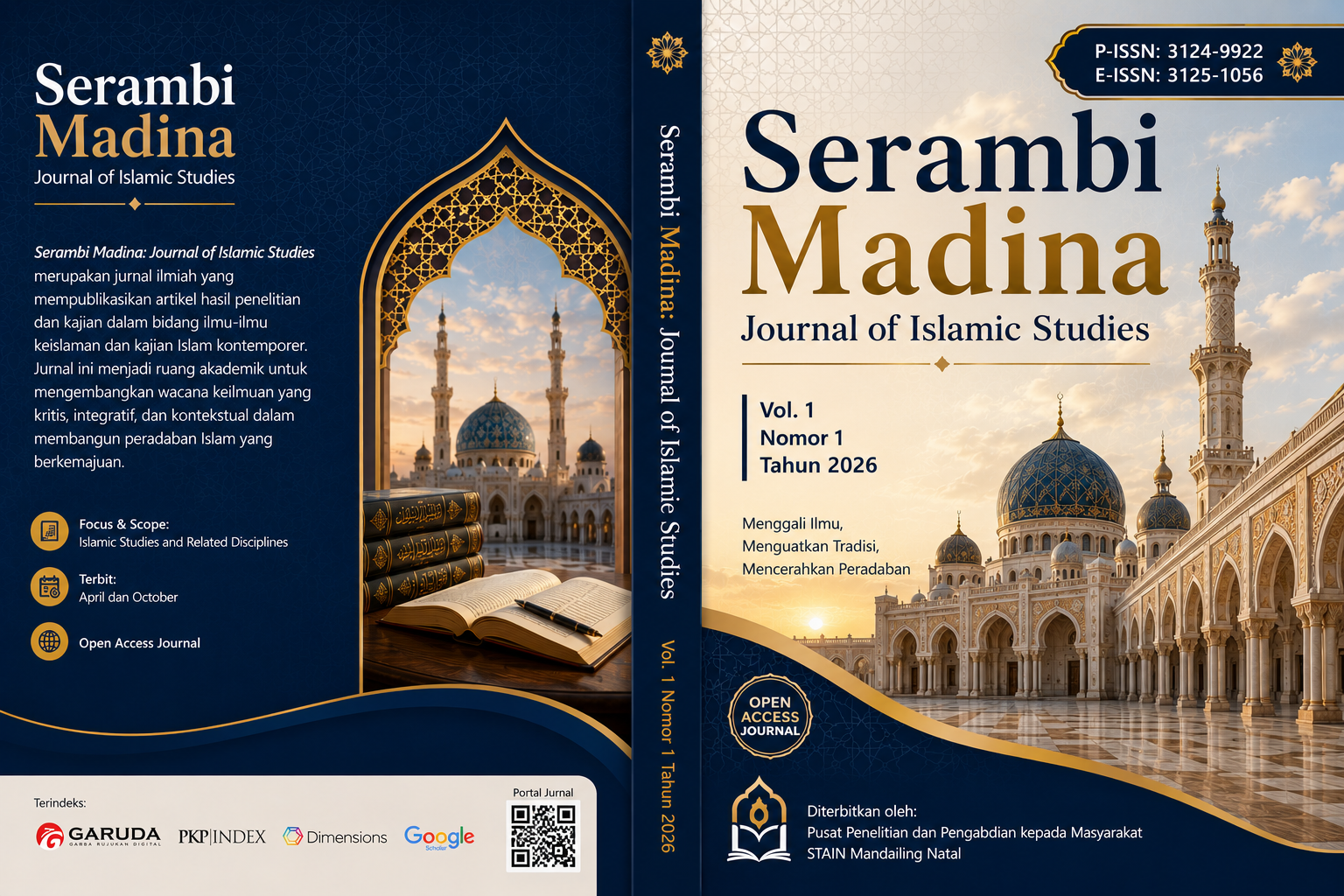
Serambi Madina: Journal of Islamic Studies is licensed under a https://creativecommons.org/licenses/by-nc-sa/4.0/
Serambi Madina: Journal of Islamic Studies is committed to supporting the open and responsible dissemination of scholarly knowledge. Accordingly, all articles published in the journal are licensed under the Creative Commons Attribution-NonCommercial-ShareAlike 4.0 International License (CC BY-NC-SA 4.0). This license grants readers, researchers, and the wider public the freedom to access, copy, distribute, and adapt published works, provided that appropriate attribution is given to the original authors, the works are not used for commercial purposes, and any derivative works are distributed under the same license. Through the implementation of this licensing policy, Serambi Madina strives to foster an inclusive, collaborative, and sustainable academic ecosystem that encourages the advancement, exchange, and global dissemination of knowledge in the field of Islamic studies at both the national and international levels.