
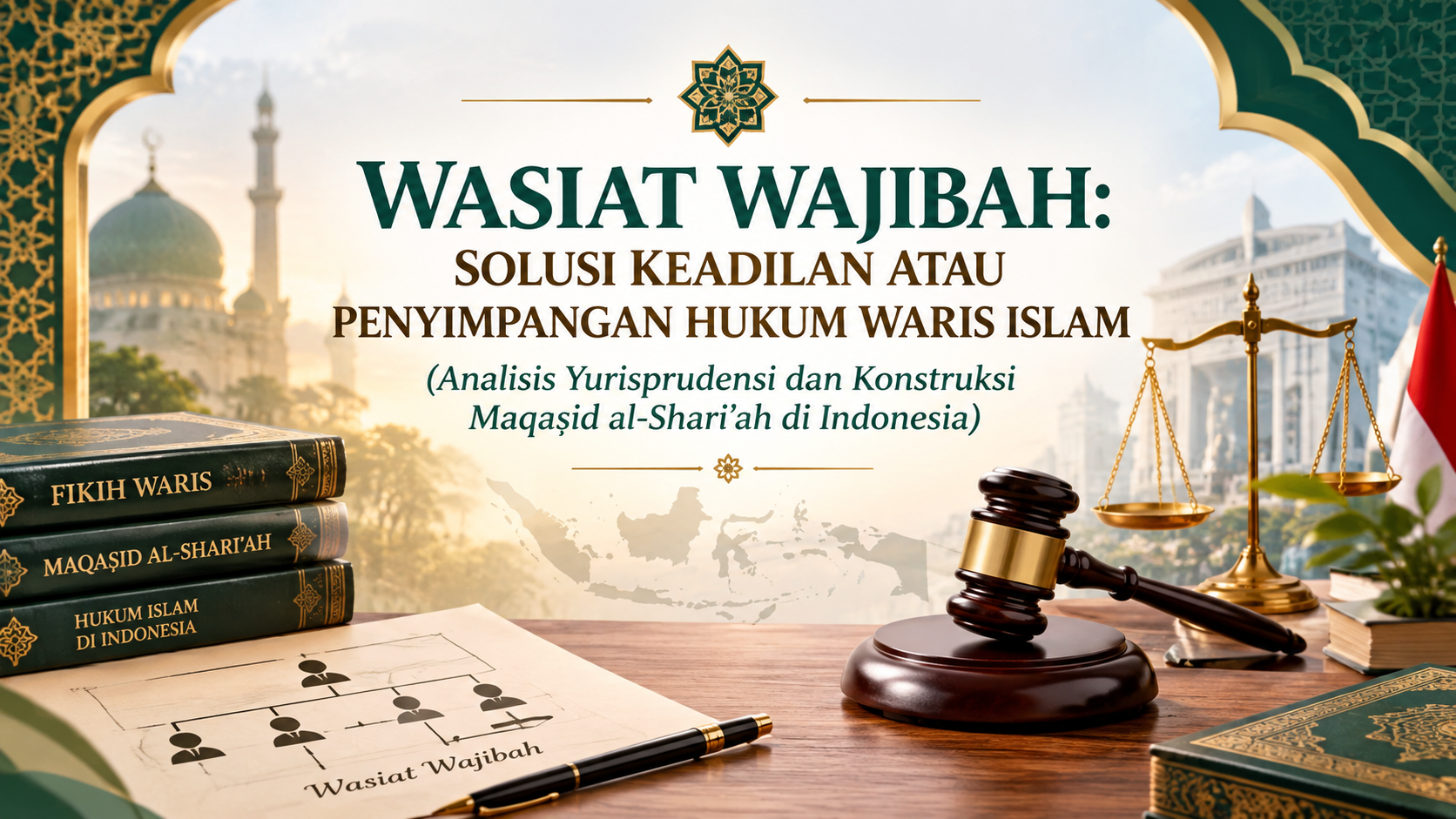
Wasiat Wajibah: Solusi Keadilan Atau Penyimpangan Hukum Waris Islam (Analisis Yurisprudensi Dan Konstruksi Maqaṣid Al-Shari’ah Di Indonesia)
DOI:
https://doi.org/10.56874/s87qw761Keywords:
Wasiat Wajibah, Interfaith Inheritance, Islamic Inheritance Law, Substantive Justice.Abstract
This study aims to examine the development of wasiat wajibah (obligatory bequest) within Indonesian Islamic inheritance law, particularly its application to non-Muslim individuals who are precluded from inheriting due to religious differences, and to examine the juridical and methodological grounds underlying this development. This study employs a normative legal research method using statutory, case, conceptual, Usul al-Fiqh, and Maqāṣid al-Sharī‘ah approaches. The cases examined include Supreme Court Decisions Nos. 368 K/AG/1995, 51 K/AG/1999, 16 K/AG/2010, 218 K/AG/2016, and 331 K/AG/2018, which demonstrate the development of wasiat wajibah for non-Muslim children and spouses. The novelty of this study lies in formulating a methodological nexus between the prohibition of interfaith inheritance and the granting of wasiat wajibah by conceptually distinguishing irth/farā’iḍ (inheritance) from wasiyyah (bequest), analyzed through an integrated Usul al-Fiqh and Maqāṣid al-Sharī‘ah approach. The findings demonstrate that judicial precedents have expanded the application of Article 209 of the Compilation of Islamic Law (KHI), which textually applies to adopted children and adoptive parents, into an instrument for granting property to non-Muslim parties who do not have the legal status of heirs. Methodologically, such a grant is not construed as an inheritance right arising from an interfaith family relationship, but rather as a transfer of property through the institution of wasiyyah, and therefore does not directly negate the prohibition against interfaith inheritance. This study concludes that wasiat wajibah may serve as an instrument of substantive justice in cases of interfaith inheritance, provided that it does not alter the recipient’s status into that of an heir and that its application is constrained by a sound legal basis, proportionality in the amount granted, and defensible parameters derived from Usul al-Fiqh and Maqāṣid al-Sharī‘ah.
Downloads
References
Achmad Roziqi. (2025). Institutional Ijtihād and Socio-Legal Adaptation: The Formulation of Waṣiyah Wājibah in Indonesia’s Compilation of Islamic Law. Asy-Syir’ah Jurnal Ilmu Syari’ah Dan Hukum, 59(1), 1–18. https://doi.org/https://doi.org/10.14421/ajish.v59i1.1517 Institutional
Akhsanty, A. S. (2025). The Concept of Wasiat and Wasiat Wajibah in Indonesia From The Perspective of The Compilation of Islamic Law ( KHI ). JOURNAL OF PRIVATE AND COMMERCIAL LAW, 2(August), 72–94. https://doi.org/https://doi.org/10.20885/JPCOL.vol2.iss1.art4 The
Baihaqi, M. (2026). Mandatory Bequest (Wasiat Wajibah) in Interfaith Inheritance Cases (A Study of Indonesian Supreme Court Decision No. 16 K/AG/2010 from the Perspective of Maqāṣid al-Sharī‘ah). Quru’: Journal of Family Law and Culture, 4(1), 121–148. https://doi.org/https://doi.org/10.59698/quru.v4i1.576
Fahimah, I. (2024). Interfaith Inheritance in Muslim Families in Indonesia: Practices, Philosophy, and the Direction of National Inheritance Law Development. Ahkam: Jurnal Ilmu Syariah, 24(2), 306–312.
Fahimah, I., & Gusmansyah, W. (2024). Inheritance within Muslim Families in Indonesia : Practices , Philosophical Foundations , and Prospects for the Development of National Inheritance Law. Ahkam : Jurnal Ilmu Syariah Interfaith, 24(2), 379–396. https://doi.org/https://doi.org/10.15408/ajis.v24i2.40907
Faradhilla Nursyahda. (2026). Wasiat Wajibah dalam Penyelesaian Sengketa Kewarisan Perkawinan Beda Agama di Indonesia : Analisis Hukum Kewarisan Islam dan Hukum Perdata ( Burgerlijk Wetboek ). Legal Standing Jurnal Ilmu Hukum, 10(1), 103–118. https://doi.org/https://doi.org/10.24269/ls.v10i1.13162
Fawzi, R. (2023). Legal Discovery Method for Non-Muslim Heirs as Recipients of Wasiat Wajibah. Jurnal Hukum Islam, 22(1), 161–188.
Hasan, M. (2025). Pembagian Warisan Antara Ahli Waris Beragama Berbeda dengan Ahli Waris Menurut Kompilasi Hukum. Academia Open Vol., 10(2), 1–14. https://doi.org/10.21070/acopen.10.2025.12147
Hidayati, S., Rusli, R., Ahmad, W., & Adnan, M. (2025). Reconstructing Divine Authority in Indonesian Islamic Law: A Critical-Maqāṣid Epistemology and the Reinterpretation of Wasiat Wājibah for Non-Muslim Heirs. Jurnal Indo-Islamika, 15(2), 244–258. https://doi.org/10.15408/jii.v15i2.49045
Lubis, R. R., Asmuni, A., Mukharrom, T., Seroza, C. B., & Kahar, A. (2025). Towards Legal Justice : Expanding Criteria for Obligatory Bequests in Unregistered Wives in Polygamous Marriages. Al-Ahkam, 35(1), 117–146. https://doi.org/10.21580/ahkam.2025.35.1.25358
Luntajo, M. M., & Hasan, F. (2025). Inheritance across faiths in Muslim Minahasa families: Legal pluralism and cultural adaptation in Manado, Indonesia. Journal of Islamic Economics Lariba, 11(1), 617–644. https://doi.org/10.20885/jielariba.vol11.iss1.art24
Mahkamah Agung. Putusan No. 16K/AG/2010 perihal hak istri yang berbeda agama dengan suami yang telah meninggal (2010). Jakarta.
Mastiningrum, E., & Faradilla, M. R. (2025). Mandatory Bequests for Non-Muslim Adopted Children and Stepchildren Perspective of Indonesian Islamic Law. Mimbar Ysutitia: Jurnal Hukum Dan …, 9(1), 61–70. https://doi.org/10.52166/mimbar.v7i2
Nizar, A., Syamwil, M., Syaputra, A., & Syahmedi, R. (2026). Mandatory Wills as a Legal Instrument in Resolving Interfaith Inheritance in Indonesia. Jurnal Sahabat ISNU-SU, 3(January), 115–122.
Palasenda, N. F. (2025). Analysis of Maqasid Shari’ah on Religious Court Decisions on the Granting of Compulsory Wills to Non-Muslim Heirs. DIKTUM: Jurnal Syariah Dan Hukum, 23(2), 132–148. https://doi.org/10.35905/diktum.v23i2.11577
Panjaitan, B. S. (2025). Pandangan Majelis Ulama Indonesia (MUI) Labuhanbatu Utara Tentang Pembagian Harta Warisan Bagi Ahli Waris Beda Agama: Kajian Yuridis-Sosiologis. MAQASID : Jurnal Studi Hukum Islam, 14(3), 251–262.
Pasyah, T. (2025). Problematika Wasiat Wajibah dalam Hukum Kewarisan di Ondonesia. Reportorium: Jurnal Ilmiah Hukum Kenotariatan, 14(2), 43–54. https://doi.org/10.28946/rpt.v14i2.5145
Putri, F. D. (2025). Pertentangan Kompilasi Hukum Islam dengan Putusan MA tentang Waris Beda Agama: Studi Kasus No. 331 K/Ag/2018. Muadalah Jurnal Hukum, 5(2), 72–91. https://doi.org/https://doi. org/10.24912/jbmi.v6i1.23743.
Ramadhani, A. G., Ngadino, N., & Irawati, I. (2019). Pelaksanaan Wasiat Wajibah Menurut Kompilasi Hukum Islam Dalam Praktek Pengadilan Agama Sambas. Notarius, 13(1), 37–46. https://doi.org/10.14710/nts.v13i1.29160
Riyanta, Najib, A. M., Bahiej, A., & Falah, M. B. (2025). Toward Interfaith Equality in Islamic Inheritance Law: Discourse and Renewal of Judicial Practice in Indonesia. Al-Manahij: Jurnal Kajian Hukum Islam, 19(1), 1–16. https://doi.org/10.24090/mnh.v19i1.10762
Setyawan, R., Witro, D., Busni, D., Kustiawan, M. T., & Syahbani, F. Z. M. (2024). Contemporary Ijtihad Deconstruction in The Supreme Court: Wasiat Wajibah as An Alternative for Non-Muslim Heirs in Indonesia. Jurnal Ilmiah Al-Syir’ah, 22(1), 25–40. https://doi.org/10.30984/jis.v22i1.2968
Shesa, L. (2018). Keterjaminan Kedudukan Dzaul Arham Dalam Kewarisan Islam Melalui Wasiat Wajibah. Al-Istinbath : Jurnal Hukum Islam, 3(2), 145. https://doi.org/10.29240/jhi.v3i2.615
Syahid Hidayatulloh, & Budiwati, A. (2025). Legal Education on Inheritance Law for Family Conflict Mitigation. Jurnal Dusturiyah, 15(1), 72. https://doi.org/10.22373/dusturiyah.v15i1.29200
Wahyudi, M. I. (2021). Melacak Illat Hukum Larangan Waris Beda Agama. Jurnal Hukum Dan Peradilan, 10(1), 155. https://doi.org/10.25216/jhp.10.1.2021.155-172
Yamin, M. (2026). The Expansion of Wasiat Wajibah : Protecting Legal Certainty and Fairness in Indonesian Inheritance Law. Fikri: Jurnal Kajian Agama, Sosial Dan Budaya, 10(2), 1011–1029. https://doi.org/https://doi.org/10.25217/jf.v10i2.7265
Zubaidi, Z., Kurdi, M., Habibi MZ, M., & Oktarina, A. (2024). Persepsi Ulama Dayah Aceh terhadap Perluasan Fikih Mawani‘ al-‘Irthi dalam KHI: Resistensi atau Adaptasi? Media Syari’ah : Wahana Kajian Hukum Islam Dan Pranata Sosial, 26(2). https://doi.org/10.22373/jms.v26i2.25917
Zubair, A., Latif, H., & Hariyanto, A. F. D. (2022). The Construction of Inheritance Law Reform in Indonesia: Questioning the Transfer of Properties through Wasiat Wājibah to Non-Muslim Heirs. Samarah, 6(1), 176–197. https://doi.org/10.22373/SJHK.V6I1.12628
Downloads
Published
Issue
Section
License
Copyright (c) 2026 Nurul Husnawati, Muhammad Adam HR, Cecep Soleh Kurniawan

This work is licensed under a Creative Commons Attribution-NonCommercial-ShareAlike 4.0 International License.

Serambi Madina: Journal of Islamic Studies is licensed under a https://creativecommons.org/licenses/by-nc-sa/4.0/
Serambi Madina: Journal of Islamic Studies is committed to supporting the open and responsible dissemination of scholarly knowledge. Accordingly, all articles published in the journal are licensed under the Creative Commons Attribution-NonCommercial-ShareAlike 4.0 International License (CC BY-NC-SA 4.0). This license grants readers, researchers, and the wider public the freedom to access, copy, distribute, and adapt published works, provided that appropriate attribution is given to the original authors, the works are not used for commercial purposes, and any derivative works are distributed under the same license. Through the implementation of this licensing policy, Serambi Madina strives to foster an inclusive, collaborative, and sustainable academic ecosystem that encourages the advancement, exchange, and global dissemination of knowledge in the field of Islamic studies at both the national and international levels.