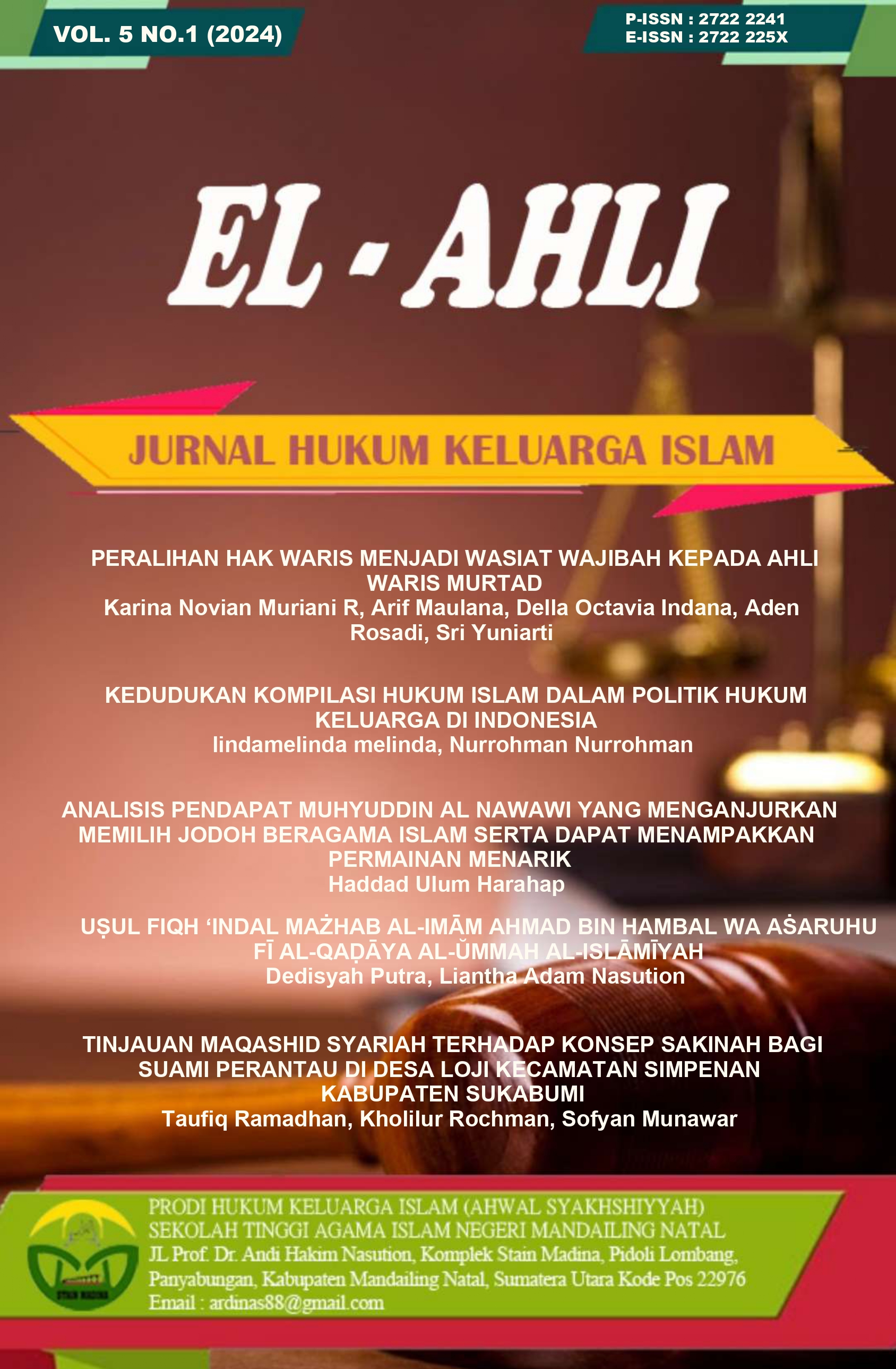
PERALIHAN HAK WARIS MENJADI WASIAT WAJIBAH KEPADA AHLI WARIS MURTAD
DOI:
https://doi.org/10.56874/el-ahli.v5i1.1844Keywords:
Waris, Murtad, Wasiat WajibahAbstract
One of the conditions for someone to receive inheritance is that one of the family members dies (muwaris) and leaves behind his/her assets. Then the heirs can obtain a portion of the inheritance in accordance with the applicable provisions (faraid). However, things are different if one of the heirs is of a different religion or converts from Islam to a religion other than Islam (apostatizes), then according to Islamic jurisprudence scholars, he is no longer an heir and absolutely does not receive a share of the inheritance of the muwaris. This article uses a qualitative descriptive method with data collection techniques in the form of literature. This article is interesting to discuss in more depth because if an heir has apostatized, he will not receive a single cent of inheritance from the muwaris because Islamic law states that a Muslim cannot inherit from a non-Muslim. This is also clearly regulated in the Compilation of Islamic Law (KHI). However, there is another option if an heir who was previously Muslim becomes an apostate, but he still wants to get a share of the inheritance, Therefore, Islamic law in Indonesia permits it by way of a mandatory will, on the condition that the gift of assets does not exceed 1/3.
Downloads
Published
Issue
Section
License
All articles published in EL-AHLI: Jurnal Hukum Keluarga Islam are licensed under a Creative Commons Attribution-ShareAlike 4.0 International License (CC BY-SA 4.0).
Under this license, authors and readers are free to:
-
Share — copy and redistribute the material in any medium or format.
-
Adapt — remix, transform, and build upon the material for any purpose, even commercially.
Under the following terms:
-
Attribution — You must give appropriate credit, provide a link to the license, and indicate if changes were made. You may do so in any reasonable manner but not in any way that suggests the licensor endorses you or your use.
-
ShareAlike — If you remix, transform, or build upon the material, you must distribute your contributions under the same license as the original.
Copyright and Licensing Policy:
-
The author retains copyright and grants the journal the right of first publication with the work simultaneously licensed under the Creative Commons Attribution-ShareAlike 4.0 International License, which allows others to share the work with acknowledgment of the work’s authorship and initial publication in this journal.
-
Authors are allowed to enter into separate, additional contractual arrangements for the non-exclusive distribution of the journal's published version of the work (e.g., post it to an institutional repository or publish it in a book), with an acknowledgment of its initial publication in this journal.
Link to License:
https://creativecommons.org/licenses/by-sa/4.0/