Influence of Gender and Online Game Addiction on Mathematical Problem-Solving Ability
DOI:
https://doi.org/10.56874/jmtl.2026.v4.i2/3148/5Keywords:
gender, online game addiction, mathematical problem solving, sequences and seriesAbstract
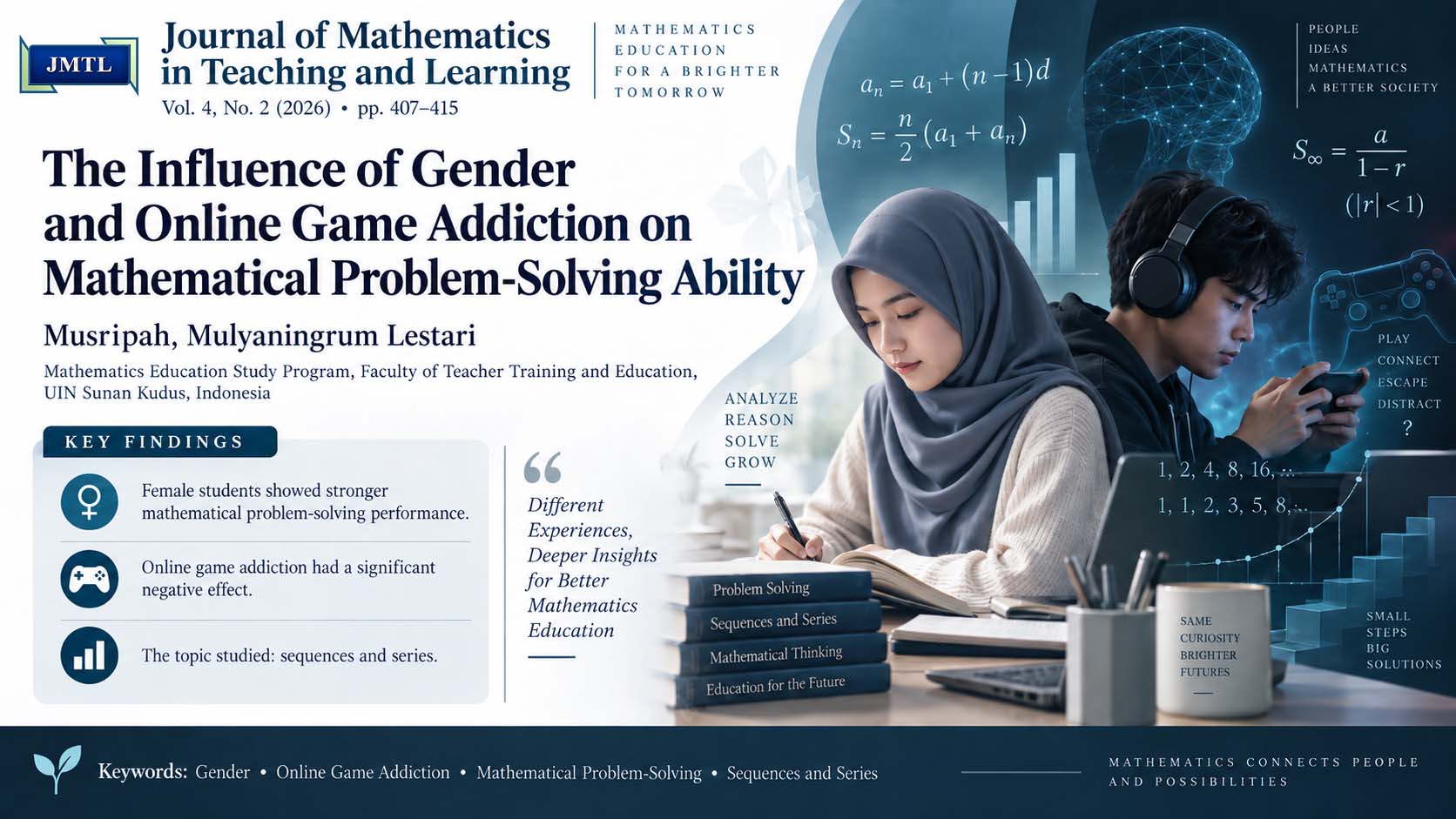
In today's digital era, online game addiction is increasingly prevalent among adolescent students, potentially impairing cognitive abilities, including mathematical problem-solving, with variations in influence based on gender. This study aims to analyze the influence of gender and online game addiction on students' mathematical problem-solving abilities in sequences and series. Using a quantitative survey approach at MA Mazro'atul Huda Karanganyar, Demak Regency, of 30 12th-grade students selected by purposive sampling from a population of 97 students, the data were analyzed using independent t-tests, regression, and F-tests. The results showed significant differences in abilities based on gender (p=0.037), with female students being superior. Online game addiction had a significant negative effect partially and simultaneously on gender. Overall, online game addiction dominated the decline in these abilities. The significance of these results underscores the urgency of educational interventions to control online game exposure, especially in male students, to improve mathematical achievement and support quality learning in secondary schools.
References
Al-Albani, M. N. (1995). Shahih al-Jami' as-Shaghir. Darul Kutub al-Ilmiyah.
Amelia, A. (2020). Hubungan kecanduan game online terhadap kemampuan pemecahan masalah mastematika siswa kelas X SMKN 2 Payakumbuh tahun pelajaran 2019/2020. Skripsi.
Arikuntoro, S. (2010). Prosedur penelitian: suatu pendekatan praktik. Rineka cipta.
Aulya, S., Fitria, L., & Yunus, Y. (2024). Perbedaan tingkat kecanduan game online antara siswa laki-laki dan perempuan di SMA Negeri 6 Padang. Jurnal ilmu sosial dan humaniora.
Bandura, A. (1986). Social foundations of thought and action : a social cognitive theory. Prentice Hall.
Departemen Agama RI. (2009). Al-Qur'an dan Terjemahannya. Departemen Agama RI.
Gentile, D. A., Li, D., Khoo, A., Prot, S., & Anderson, C. A. (2014). Mediators and moderators of long-term effects of violent video games on aggressive behavior: practice, thinking, and action. JAMA pediatrics, 450-457.
Ghozali, I. (2018). Aplikasi analisis multivariat dengan program IBM SPSS 25. Universitas Diponegoro.
Hamranani, S. S., Kusumaningrum, P. R., Permatasari, D., & Setyawan, E. A. (2021). Hubungan lama penggunaan game online dengan motivasi belajar pada remaja. Prosiding Seminar Nasional UNIMUS, 1570-1579.
Hyde, J. S., Lindberg, S. M., Linn, M. C., Ellis, A. B., & Williams, C. C. (2008). Gender similarities characterize math performance. Science, 494-495.
Kautsar, A. (2019). Pengaruh game online terhadap prestasi akademik peserta didik di MAN 3 Aceh Besar. Banda Aceh: Skripsi Universitas Islam Negeri Ar-Raniry Banda Aceh.
Kemdiknas. (2006). Peraturan Menteri Pendidikan Nasional Nomor 22 Tahun 2006 tentang Standar Isi. Kementrian Pendidikan Nasional.
Kemkominfo, & AGI. (2022). Laporan Survei Pengguna Game Online di Indonesia. Kementerian Komunikasi dan Informatika & Asosiasi Game Indonesia.
Lestari, W., Kusmayadi, T. A., & Nurhasanah, F. (2021). Kemampuan pemecahan masalah matematika ditinjau dari perbedaan gender. Jurnal Pendidikan Matematika, 45-56.
Niko, & Partners. (2022). Southeast Asia Gaming Market Report 2022. Niko Partners.
Nugraha, E. (2017). Efektivitas pembelajaran berbasis diskusi dalam mengurangi kesenjangan prestasi matematis berdasarkan gender. Jurnal Inovasi Pendidikan.
OECD. (2023). PISA 2022 result (volume I): the state of learning and equity in education. Paris: OECD Publishing.
Rahma, A., & Indrawati, Y. (2016). Pengaruh Gender Terhadap Prestasi Pemecahan Masalah Matematis di Sekolah Menengah Pertama. Jurnal Pendidikan Matematika.
Rezky, F. M. (2022). Kemampuan pemecahan masalah matematis ditinjau dari motivasi belajar pada materi barisan dan deret siswa kelas XI SMK Negeri 4 Gowa. Skripsi.
Sugiyono. (2019). Metode penelitian kuantitatif, kualitatif, dan R&D. Alfabeta.
Suryani, D. (2018). Gaya belajar dan kepercayaan diri sebagai faktor penentu perbedaan prestasi matematis siswa. Jurnal ilmiah pendidikan.
Sweller, J. (1988). Cognitive load during problem solving : Effects on learning. Cognitive science, 257-285.
Downloads
Published
Issue
Section
License
Copyright (c) 2026 Musripah, Mulyaningrum Lestari

This work is licensed under a Creative Commons Attribution-NonCommercial-ShareAlike 4.0 International License.