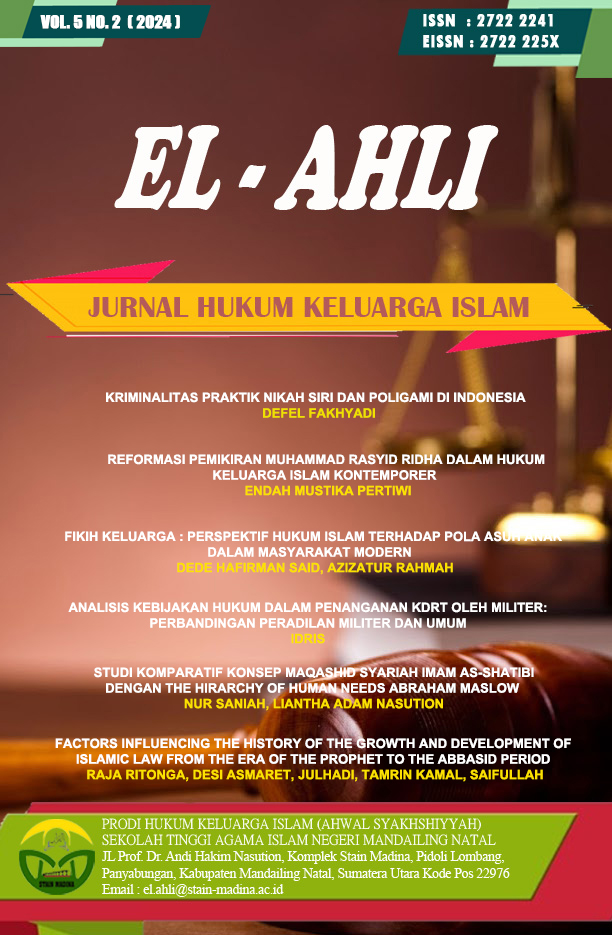
ANALISIS KEBIJAKAN HUKUM DALAM PENANGANAN KDRT OLEH MILITER: PERBANDINGAN PERADILAN MILITER DAN UMUM
Indonesia
DOI:
https://doi.org/10.56874/el-ahli.v5i2.2069Keywords:
KDRT, Peradilan Umum, Peradilan MiliterAbstract
The handling of Domestic Violence (DV) cases involving military personnel often presents a jurisdictional dilemma between military courts and civilian courts. This study aims to analyze legal policies in addressing DV committed by military personnel and to compare the differences in handling such cases between the two judicial systems. The method used is normative juridical with a comparative law approach, including an analysis of military court rulings and civilian court decisions. The research findings reveal significant differences in judicial processes and sentencing. Military courts tend to provide special treatment to perpetrators, taking into account their status as part of the military institution. On the other hand, civilian courts are more focused on the protection and recovery of victims. These differences pose challenges in ensuring justice for DV victims while maintaining military discipline within the institution. The study concludes that harmonizing legal policies between military and civilian courts is necessary to enhance the effectiveness of handling DV cases involving military personnel. This effort aims to achieve a balance between protecting victims and enforcing rules within the military environment.
Keywords : domestic violence, military courts, civilian courts
Downloads
Published
Issue
Section
License
All articles published in EL-AHLI: Jurnal Hukum Keluarga Islam are licensed under a Creative Commons Attribution-ShareAlike 4.0 International License (CC BY-SA 4.0).
Under this license, authors and readers are free to:
-
Share — copy and redistribute the material in any medium or format.
-
Adapt — remix, transform, and build upon the material for any purpose, even commercially.
Under the following terms:
-
Attribution — You must give appropriate credit, provide a link to the license, and indicate if changes were made. You may do so in any reasonable manner but not in any way that suggests the licensor endorses you or your use.
-
ShareAlike — If you remix, transform, or build upon the material, you must distribute your contributions under the same license as the original.
Copyright and Licensing Policy:
-
The author retains copyright and grants the journal the right of first publication with the work simultaneously licensed under the Creative Commons Attribution-ShareAlike 4.0 International License, which allows others to share the work with acknowledgment of the work’s authorship and initial publication in this journal.
-
Authors are allowed to enter into separate, additional contractual arrangements for the non-exclusive distribution of the journal's published version of the work (e.g., post it to an institutional repository or publish it in a book), with an acknowledgment of its initial publication in this journal.
Link to License:
https://creativecommons.org/licenses/by-sa/4.0/