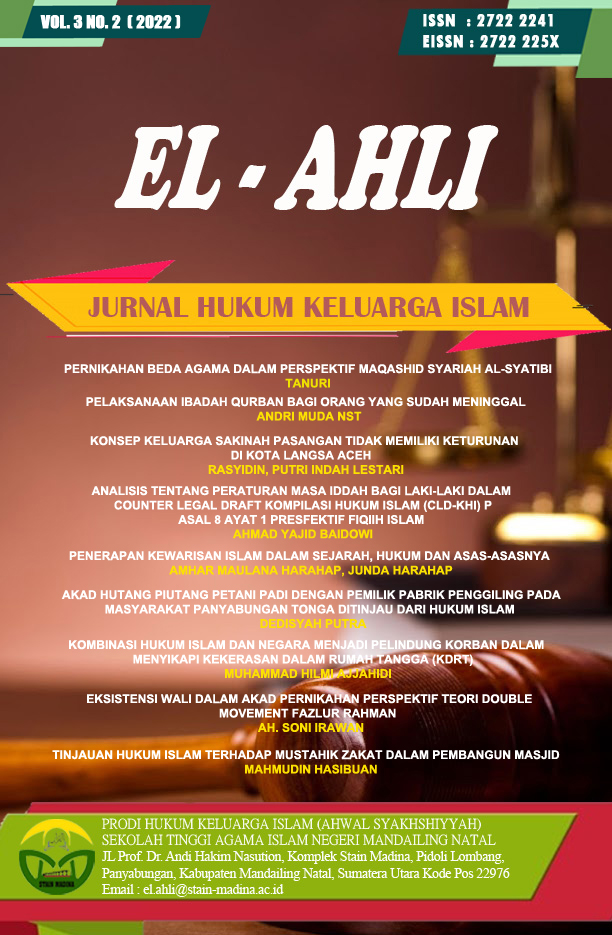
KONSEP KELUARGA SAKINAH PASANGAN TIDAK MEMILIKI KETURUNAN DI KOTA LANGSA ACEH
DOI:
https://doi.org/10.56874/el-ahli.v3i2.983Keywords:
Family, household, Marriage, SakinahAbstract
This paper focuses on the concept of the sakinah family of couples who do not have children. Domestic life is not from conflicts that arise to differences of opinion between husband and wife, but the most important thing is how to keep the family intact. The different problems that occur are also different ways to solve them, some end in divorce, some lead to harmony. A marriage that is not blessed with offspring does not mean unhappy they are also happy in their own way. As for the formulation of the problem that the author sets, how is the concept of a family without children in building a family, and what are the challenges for couples who do not have children in building a sakinah family? The author uses the type of field research ( field research). The descriptive approach to empirical analysis. The result of this paper is that in building a sakinah family, couples who do not have children have a variety of ways to do it but still have one goal, namely to build a sakinah family. According to them, the concept of a sakinah family is a family based on religion, loving each other, loving each other, trusting each, consulting each if there are problems, and solving them as well as possible so that marriage remains intact. In dealing with problems, there are various ways of solving them but still ending with happiness, because many are not happy because of problems in the household.
Downloads
Published
Issue
Section
License
All articles published in EL-AHLI: Jurnal Hukum Keluarga Islam are licensed under a Creative Commons Attribution-ShareAlike 4.0 International License (CC BY-SA 4.0).
Under this license, authors and readers are free to:
-
Share — copy and redistribute the material in any medium or format.
-
Adapt — remix, transform, and build upon the material for any purpose, even commercially.
Under the following terms:
-
Attribution — You must give appropriate credit, provide a link to the license, and indicate if changes were made. You may do so in any reasonable manner but not in any way that suggests the licensor endorses you or your use.
-
ShareAlike — If you remix, transform, or build upon the material, you must distribute your contributions under the same license as the original.
Copyright and Licensing Policy:
-
The author retains copyright and grants the journal the right of first publication with the work simultaneously licensed under the Creative Commons Attribution-ShareAlike 4.0 International License, which allows others to share the work with acknowledgment of the work’s authorship and initial publication in this journal.
-
Authors are allowed to enter into separate, additional contractual arrangements for the non-exclusive distribution of the journal's published version of the work (e.g., post it to an institutional repository or publish it in a book), with an acknowledgment of its initial publication in this journal.
Link to License:
https://creativecommons.org/licenses/by-sa/4.0/