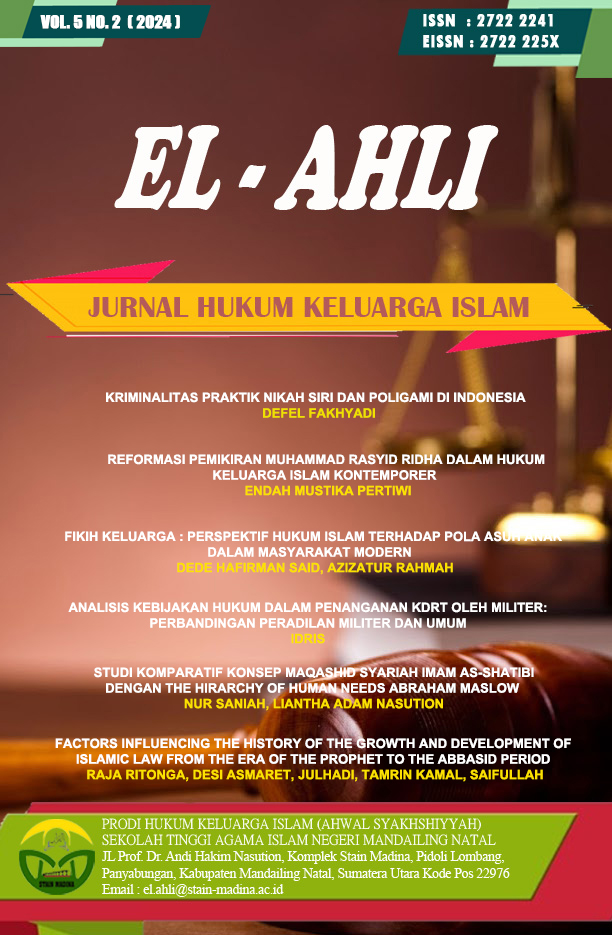
FIKIH KELUARGA : PERSPEKTIF HUKUM ISLAM TERHADAP POLA ASUH ANAK DALAM MASYARAKAT MODERN
DOI:
https://doi.org/10.56874/el-ahli.v5i2.2087Keywords:
Fikih Keluarga, Pola Asuh Anak, Hukum Islam, Masyarakat ModernAbstract
Abstract
Parenting styles play a crucial role in shaping a child's character and behavior, which in turn influences their future social and psychological life. In today's modern era, parenting patterns are increasingly influenced by a variety of factors, such as social changes, technological advancements, and shifts in cultural values. This study aims to explore Islamic perspectives on child-rearing practices in the context of contemporary society, with a focus on the fundamental principles of family jurisprudence. The methodology employed is a literature review, which analyzes both classical and modern interpretations of Islamic law, particularly those related to family jurisprudence, and examines their application in the context of child-rearing. The findings of this research indicate that Islamic law offers clear guidelines for raising and nurturing children, emphasizing the importance of balancing love, discipline, and religious education. Islam also stresses the protection of children's rights, including the right to quality education and a healthy environment. However, the challenges faced by parents in modern society—such as the influence of globalization, technology, and changing cultural values—require a rethinking of these principles to ensure they remain relevant and effective in guiding children. In conclusion, this study highlights that despite differences in cultural and social approaches, the principles of family jurisprudence continue to provide a solid foundation for establishing effective parenting strategies in the face of modern societal dynamics.
Downloads
Published
Issue
Section
License
All articles published in EL-AHLI: Jurnal Hukum Keluarga Islam are licensed under a Creative Commons Attribution-ShareAlike 4.0 International License (CC BY-SA 4.0).
Under this license, authors and readers are free to:
-
Share — copy and redistribute the material in any medium or format.
-
Adapt — remix, transform, and build upon the material for any purpose, even commercially.
Under the following terms:
-
Attribution — You must give appropriate credit, provide a link to the license, and indicate if changes were made. You may do so in any reasonable manner but not in any way that suggests the licensor endorses you or your use.
-
ShareAlike — If you remix, transform, or build upon the material, you must distribute your contributions under the same license as the original.
Copyright and Licensing Policy:
-
The author retains copyright and grants the journal the right of first publication with the work simultaneously licensed under the Creative Commons Attribution-ShareAlike 4.0 International License, which allows others to share the work with acknowledgment of the work’s authorship and initial publication in this journal.
-
Authors are allowed to enter into separate, additional contractual arrangements for the non-exclusive distribution of the journal's published version of the work (e.g., post it to an institutional repository or publish it in a book), with an acknowledgment of its initial publication in this journal.
Link to License:
https://creativecommons.org/licenses/by-sa/4.0/